February 3, 2026
.webp)
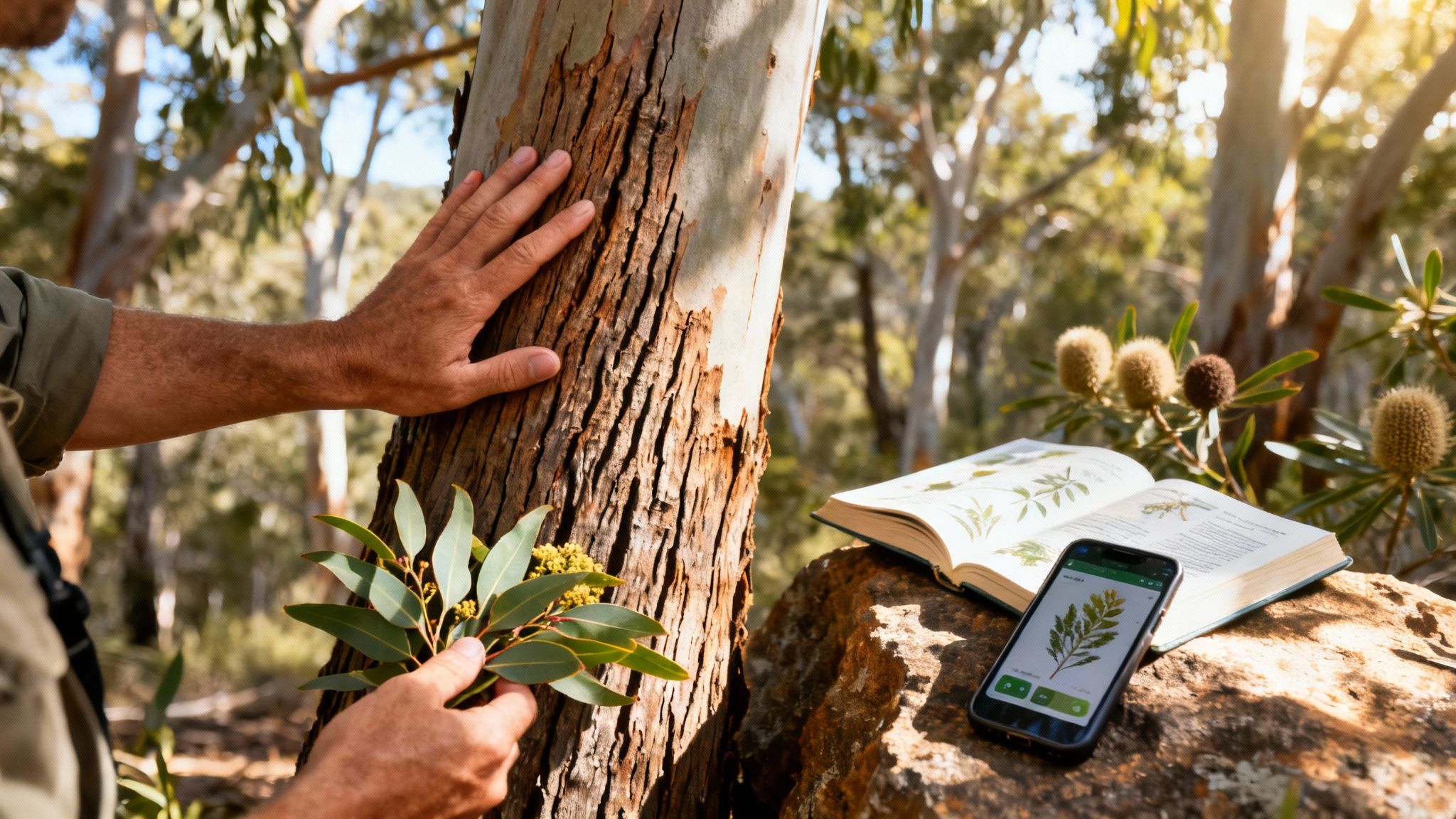
Identifying Trees Australia: A Field Guide to Australian Tree Identification
Discover identifying trees australia with a concise field guide to Australian species, key features, and practical tips to identify trees confidently.
Career Development
minutes
Trying to identify a tree in Australia can feel like a massive task. With tens of thousands of species out there, where do you even start? The secret isn't to memorise them all overnight, but to learn how to look. It all boils down to building a reliable, systematic method you can use anywhere, from a local park to the deep bush.
Once you nail this process, you’ll be able to confidently identify the diverse flora this country has to offer.
Where to Begin With Australian Tree Identification
The first step is simply learning to observe properly. Forget trying to guess based on the overall shape alone and instead, focus on a few key features. This methodical approach is the foundation of accurate identification and is a vital skill for anyone interested in their local environment.
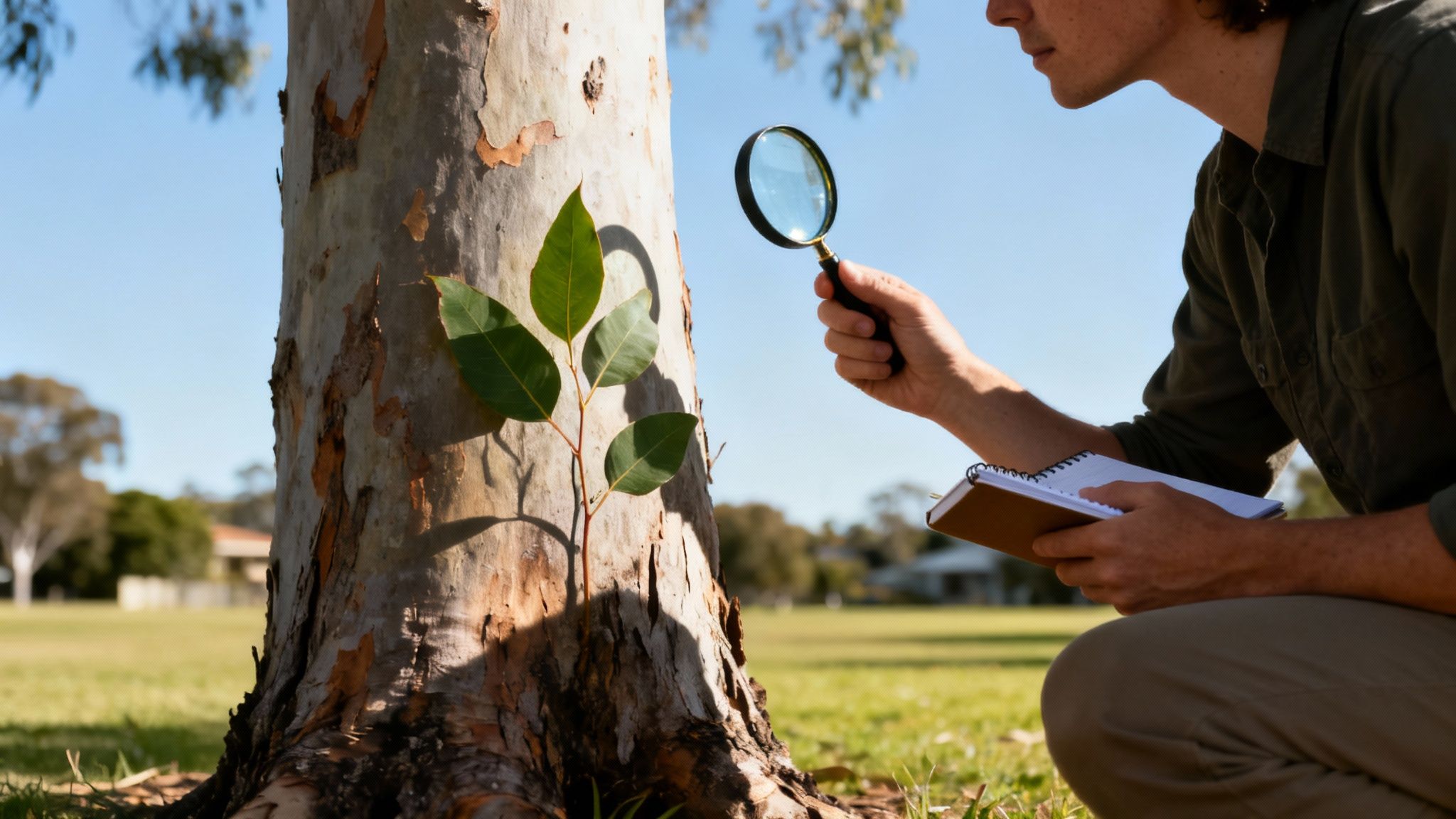
It’s also a cornerstone of professional training. For anyone looking to take their knowledge further, the fundamentals taught in a certificate of horticulture can turn a casual interest into genuine expertise.
Start with the Big Picture
Before you get your magnifying glass out, take a step back and look at the tree's surroundings. Understanding its ecological context can instantly narrow down the possibilities. A great resource for this is A Guide to the Biomes of the World. Ask yourself: where is this tree growing? Is it in a coastal heath, a dry sclerophyll forest, or a temperate rainforest?
Next, consider the tree’s overall form, or what botanists call its habit.
- Is it a giant with a single trunk or a multi-stemmed mallee?
- Does it have a weeping form, like some wattles, or is it straight and conical?
- Is it a lone soldier or part of a dense, crowded canopy?
This initial scan gives you a solid framework before you dive into the finer details.
The Four Foundational Clues
With the general context sorted, it's time to zoom in on the four key identifiers that will give you the most reliable clues. These are the details you'll use to cross-reference with field guides, websites, and identification apps.
When you first approach a tree, it helps to have a mental checklist. The table below summarises the key features to look for to build a comprehensive profile of the specimen.
Key Observational Clues for Tree Identification
By running through these four features every time, you create a complete picture. This systematic habit stops you from jumping to a conclusion based on just one feature, which can often be misleading.
Australia is home to an incredible 24,000 species of native plants, making it one of the world's botanical hotspots. Eucalypts are king here, covering 77% of the country's native forest area, with acacias (wattles) making up another 8%. Getting to know even a fraction of them starts with these simple, observational steps.
Getting to Know a Tree by Its Leaves and Bark
When you're trying to figure out what tree you're looking at in Australia, your two best mates are the leaves and the bark. Flowers and fruit are fantastic clues, but they're seasonal visitors. Leaves and bark, on the other hand, are on display all year round. Learning to read them is the difference between a wild guess and a confident identification.
This kind of detailed observation is a fundamental skill for anyone working with plants, from local gardeners to conservation land managers. And if you're looking to understand the whole picture, it pays to know the other locals, too. Our guide to Australian native ferns is a great place to start identifying the understory plants you'll find growing in the shade of these trees.
Reading the Story of a Leaf
It’s amazing how much a single leaf can tell you. Don't just give it a quick glance; you need to look at it systematically. The very first thing to check is how the leaves are attached to the twig—it’s one of the first questions you'll be asked in any botanical key.
- Opposite Arrangement: Leaves sprout in pairs, directly across from each other on the stem. You won't see this as often in our native trees, but some Lilly Pilly species are a good example.
- Alternate Arrangement: Leaves are staggered up the stem, appearing one at a time. This is the most common layout you'll find, classic for Eucalypts and Acacias.
Next, get a good look at the leaf's shape, its edges (margins), and the pattern of its veins. Is it long and thin like a dagger (lanceolate), or is it more egg-shaped (ovate)? Are the edges perfectly smooth (entire), or are they jagged like a saw (serrated)? These seemingly minor details are what will help you nail the ID.
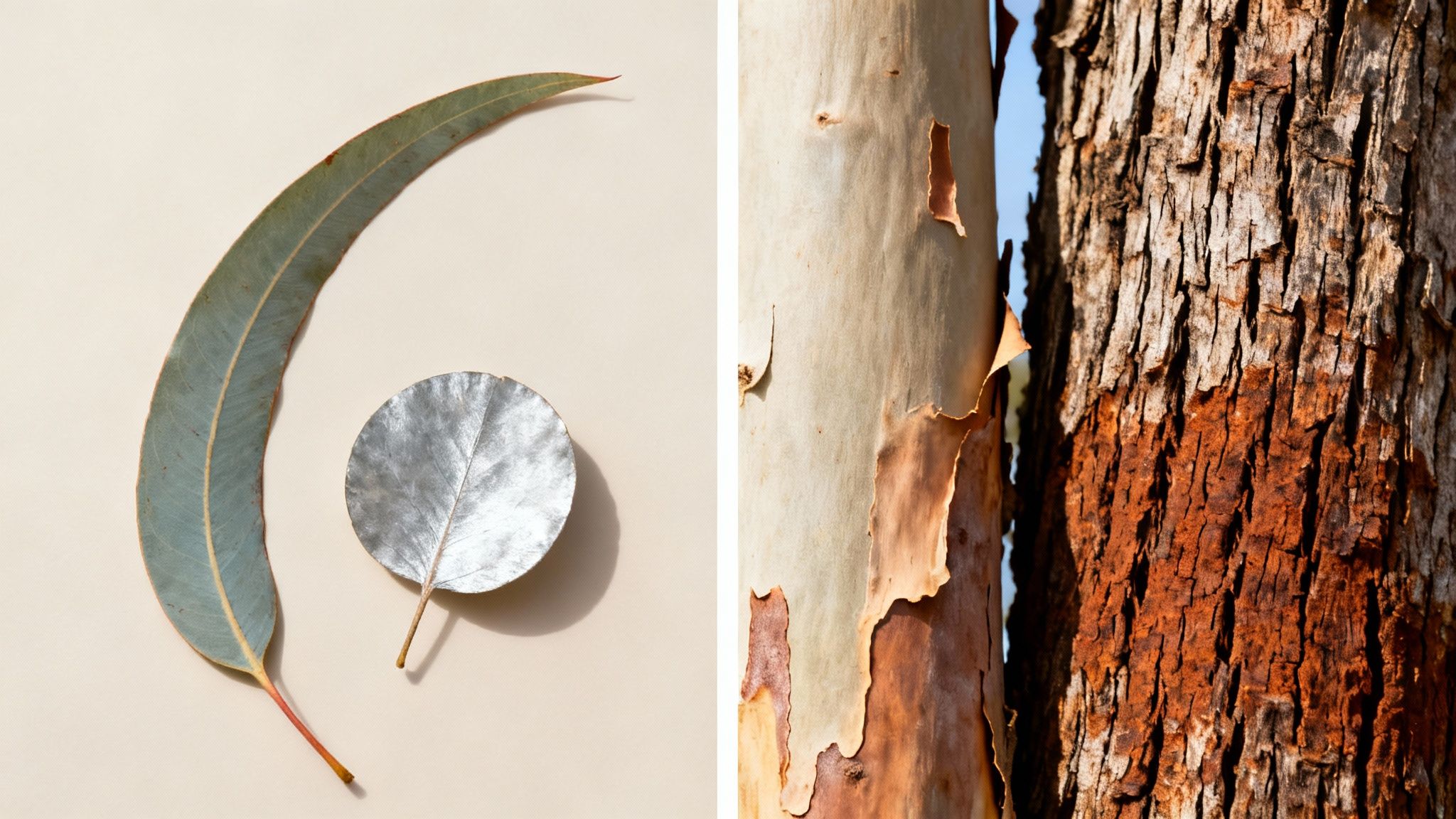
A classic example is the Blue Gum (Eucalyptus globulus). Its adult leaves are long, curved, and sickle-shaped. But its juvenile foliage—the leaves on young trees or new growth after a fire—is completely different. They're round, silvery-blue, and grow in opposite pairs that almost hug the stem. If you see both leaf types on or around the same tree, that's a massive clue.
Unpacking the Clues in the Bark
Bark is so much more than a tree's protective skin. Think of it as a detailed record of the tree's species, its age, and the environment it has grown up in. To get good at this, you need to move beyond simple descriptions like 'smooth' or 'rough', especially when you’re dealing with the massive Eucalyptus genus.
Learning the different bark types is a total game-changer for identifying trees in Australia. Each one tells a story about the tree's identity and how it's adapted to its surroundings, particularly fire.
Key Australian Bark Types
Get right up close. Touch the bark. Is it rock-hard, or can you peel off fibrous strands?
- Stringybark: Thick, fibrous, and made of long strands. You can usually pull off coarse, stringy pieces. This type provides fantastic insulation against bushfires.
- Ironbark: Deeply grooved, incredibly hard, and often a dark red or black colour. It’s saturated with kino (a type of sap), which makes it super dense and resistant to both fire and termites.
- Box Bark: Short-fibred with a tessellated or flaky look. It feels a bit brittle and tends to break off in small, chunky bits.
- Smooth Bark (Gum): This is the bark that sheds every year in ribbons, flakes, or big plates, revealing a fresh, smooth layer underneath. This shedding can create stunning colours, from white and grey to yellow, pink, and even blue.
- Scribbly Gum Bark: A special type of smooth bark, famous for the intricate zigzag "scribbles" left by the larvae of the scribbly gum moth burrowing just beneath the surface.
By putting together your observations of both leaves and bark, you create a powerful, two-pronged approach. An alternate, lanceolate leaf tells you part of the story. But when you pair that with the fact that it's on a tree with hard, black, deeply ridged ironbark, you've suddenly narrowed down the possibilities in a huge way. This multi-feature analysis is the secret to confidently navigating Australia's incredible diversity of trees.
Using Flowers and Fruits to Confirm Your ID
While leaves and bark are your year-round companions for identifying trees in Australia, flowers and fruits are the seasonal showstoppers that provide definitive proof. Think of them as the final, compelling piece of evidence that locks in a positive identification with confidence.
Their appearance, though often fleeting, offers some of the clearest and most distinct clues you'll find.
Sure, these are often the most beautiful parts of a tree, but to a keen observer, they're absolutely packed with vital information. Paying attention to them elevates your skills from making an educated guess to reaching a well-supported conclusion.
Examining the Structure of Australian Flowers
The word 'flower' might conjure a standard image of petals around a centre, but Australian flora loves to break the rules. Our native flowers are incredibly diverse, and their unique structures are powerful identification markers.
When you find a tree in bloom, don't just note the colour; look closer at its actual form. You'll quickly see patterns emerge that are specific to certain plant families.
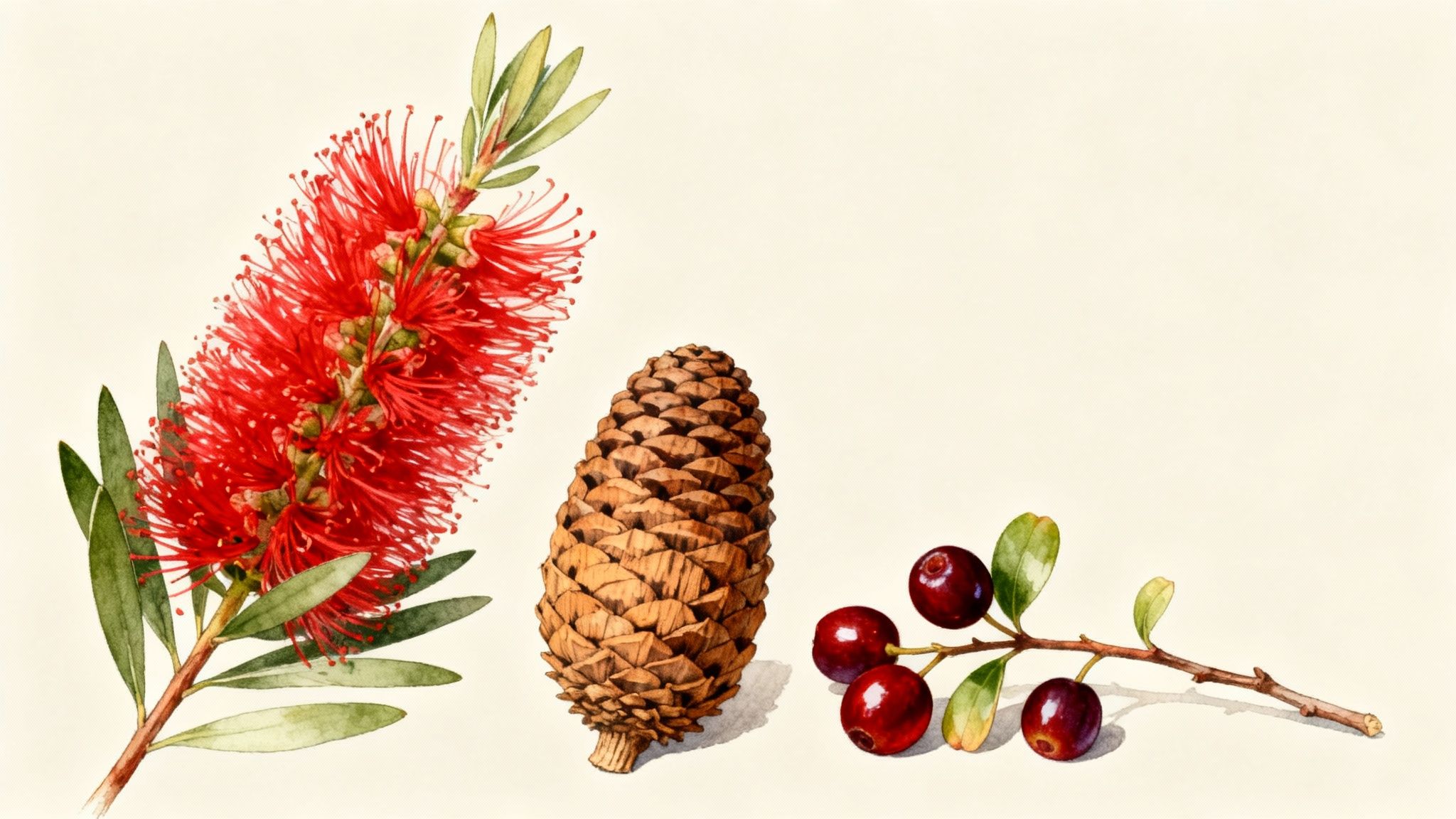
- Brush-like Flowers: Many iconic Aussie plants, like Bottlebrushes (Callistemon) and Grevilleas, have flowers that look like brushes. What you're actually seeing aren't petals, but hundreds of prominent stamens (the pollen-producing parts), perfectly designed to be pollinated by birds and small marsupials.
- Pea Flowers: Wattles (Acacia) and many other legumes produce flowers that are either fluffy, globe-shaped balls or cylindrical spikes. These are actually dense clusters of dozens of tiny individual flowers.
- Subtle Blossoms: Not all flowers are flamboyant. The flowers of a Sheoak (Casuarina) are incredibly subtle and easily missed. Male trees produce small, brownish spikes at the tips of their branchlets, while female flowers are tiny, reddish tufts that appear along the branches.
When identifying a tree, the flower is often the botanical equivalent of a fingerprint. For example, telling apart the hundreds of Eucalypt species can feel impossible with leaves alone. However, the size, shape, and grouping of their flower buds (the operculum or 'cap' that covers the stamens) are critical distinguishing features used by botanists.
What Fruits and Seeds Reveal
After the flowers fade, the fruit, nuts, and seeds that develop offer another fantastic layer of clues. These parts are often tough and persistent, meaning you can find them on the tree or scattered on the ground long after the flowering season has passed. This makes them a reliable feature to check at almost any time of year.
Again, the diversity is astounding, and each type tells a story.
Common Types of Australian Fruits and Seeds
Look on the branches and on the forest floor beneath the tree. You'll likely find a treasure trove of evidence just waiting to be examined.
- Woody Capsules (Gumnuts): This is the classic fruit of the Eucalyptus family. 'Gumnuts' are hard, woody capsules that open up to release tiny seeds. Their shape—be it urn-shaped, spherical, or conical—is one of the most reliable ways to differentiate between Eucalypt species.
- Follicles and Cones: Banksias and Hakeas produce hard, woody follicles that often look like cones. These are famously persistent and will stay on the plant for years, only opening to release their winged seeds after the heat of a bushfire.
- Fleshy Fruits: Many rainforest species and plants like the Lilly Pilly (Syzygium) produce soft, fleshy berries. Their colour, size, and shape are key identifiers, though be aware that many native fruits are not edible for humans.
Finally, don't forget to step back and look at the tree’s overall shape or habit. Is it a tall, slender Mallee that grows from a lignotuber, or a sprawling, multi-stemmed Melaleuca thriving in a swampy area? Combining these observations of flowers, fruits, and overall form with what you've learned from the leaves and bark gives you a complete picture for a much more accurate and satisfying identification.
Your Location is the Best Clue: Using Geography and Digital Tools
Sometimes, the most powerful clues for identifying a tree have nothing to do with its leaves or bark. Context is everything. A tree’s identity is deeply tied to its surroundings, so learning to read the landscape and use a bit of modern tech can seriously speed up the process.
Think of yourself as a nature detective. The tree’s location is your first major lead. Australia’s ecosystems are incredibly diverse, and most plants have specific regions they call home. A tree thriving in the wet tropics of Queensland is almost certainly not the same species you’d find braving the alpine chill in Tasmania.
For example, you’d be wasting your time looking for a Jarrah (Eucalyptus marginata), which is endemic to southwest Western Australia, in a Sydney national park. Just knowing where you are immediately rules out thousands of possibilities.
Let the Region and Season Guide You
Before you even reach for your phone or field guide, stop and ask yourself two simple questions.
- Where am I, really? Are you in a windswept coastal heathland in Victoria? A dry, crackly sclerophyll forest in New South Wales? A monsoonal woodland up in the Northern Territory? Each of these environments supports a unique community of plants.
- What time of year is it? Timing is another huge giveaway. If a tree is absolutely covered in brilliant yellow flowers in the middle of winter, there’s a very good chance you’re looking at a Wattle (Acacia), as many species put on their big show then.
Combining place and time helps you build a profile of what’s likely to be there. This is a classic botanical trick that grounds your search in the real world, making it far less overwhelming and much more targeted.
Making the Most of Digital ID Tools
Once you’ve gathered your on-the-ground observations, technology can be a brilliant sidekick. A whole host of Australian plant identification apps and online resources can help you cross-reference what you’ve found and suggest potential matches.
These tools are fantastic for getting a quick suggestion, but it’s smart to use them with a healthy dose of scepticism. They rely on image recognition, and while the algorithms are getting better all the time, they can still get stumped by the subtle differences between closely related Australian species.
A digital app is best used as a starting point, not a final verdict. Use its suggestions to guide your research in a reliable field guide or botanical website, rather than just taking the first answer it spits out. This blended approach gives you both speed and accuracy.
The sheer scale of Australia’s biodiversity is immense. A groundbreaking 2022 study estimated there are 73,000 tree species worldwide, with a mind-boggling 9,200 yet to be discovered. The research pointed out that northeast Australia's tropical and subtropical forests could be hiding around 1,500 of these unknown species. You can learn more about these incredible findings from Western Sydney University researchers. This just goes to show how complex—and exciting—identifying trees in Australia can be.
Popular Australian Tree Identification Apps
When you’re looking for a digital tool, it helps to know what each one does best. Some are great for beginners just getting started, while others offer more robust features for serious enthusiasts. Here’s a quick comparison of top-rated digital tools to help you choose the best app for your needs, whether you're a hobbyist or a professional.
Ultimately, the most effective strategy is a hybrid one. Combine your own careful observations of the tree's features with an understanding of its location and the season. Then, use digital apps and online keys as powerful tools to test your ideas and point you in the right direction. This balanced method will build your confidence and lead to faster, more reliable results out in the field.
Your Field Checklist for Confident Identification
Theory is one thing, but getting your hands dirty is where your tree identification skills will really take off. To do this properly, you need a system. A simple field checklist is your best friend out in the bush, making sure you capture every clue without missing the one detail that could solve the whole puzzle.
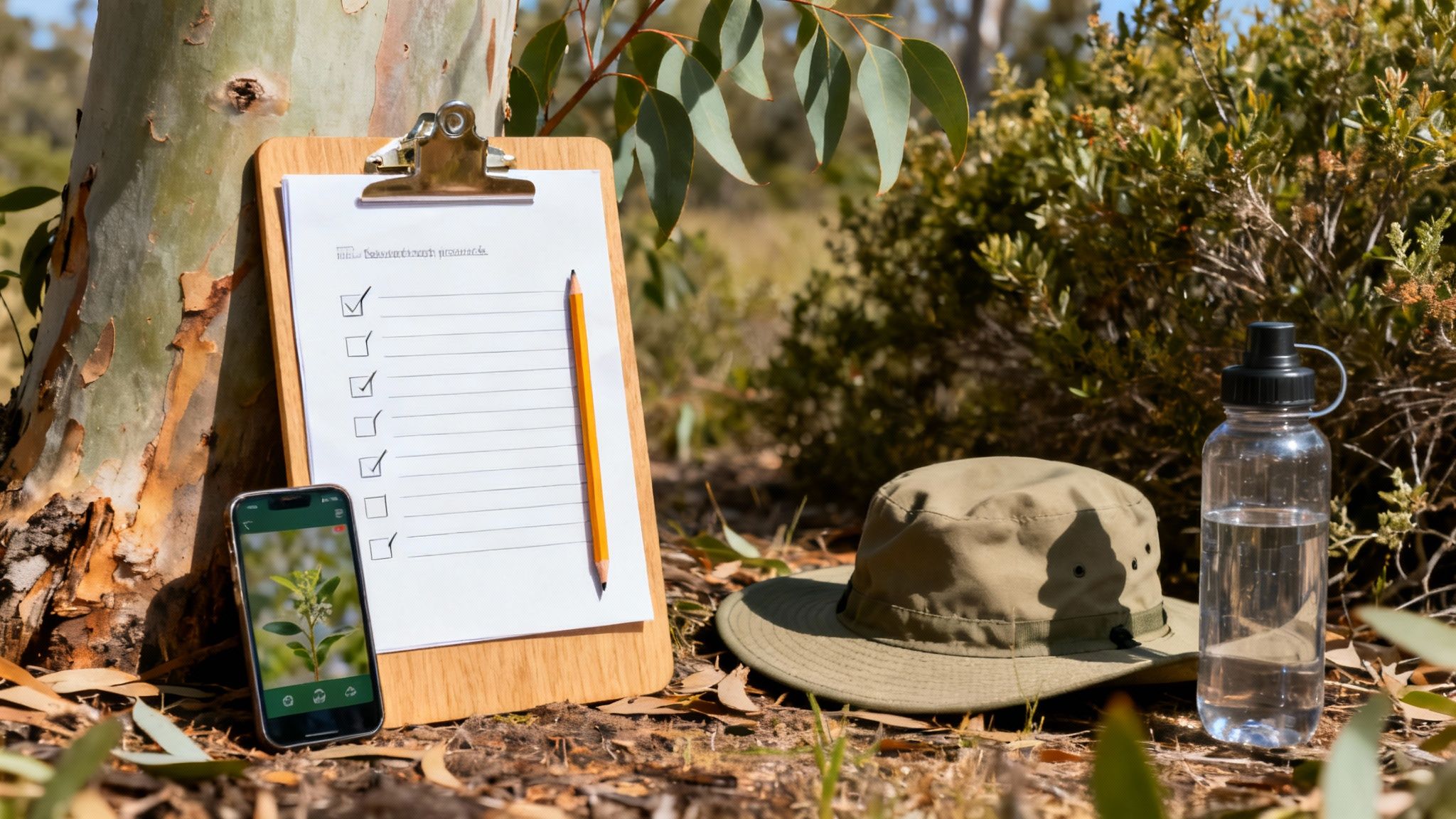
This isn't just about glancing at a tree; it's about shifting into a more structured, almost scientific mindset. It forces you to slow down and really look, which is the secret to building both accuracy and confidence.
Your Systematic Observation Checklist
Before you even step out the door, grab a notebook or get a notes app ready on your phone. For every tree you plan to identify, methodically work through this list. What you're doing is building a detailed profile of the tree, something you can then confidently compare against field guides or online resources.
Context and Location:
- Note the date and your general location (e.g., Blue Mountains, NSW).
- What’s the immediate environment like? Is it a damp, dense rainforest, a dry open woodland, a coastal dune system, or a suburban park?
- What other plants are dominant in the area? This can give you big clues.
Overall Form (Habit):
- Give a rough estimate of its height and width. Is it a towering giant or a smaller tree?
- Does it have one straight trunk, or is it a multi-stemmed mallee growing from the base?
- Describe the canopy shape. Is it conical like a pine, spreading wide, weeping, or sparse and scraggly?
Bark Examination:
- What’s the main colour and texture? Get up close.
- Is it smooth? Peeling in ribbons? Fibrous and stringy (stringybark)? Hard and deeply furrowed (ironbark)? Or broken up into little squares (box bark)?
- Look for unique markings. Can you see any insect scribbles or spots where sap has bled out (kino)?
Leaf Details:
- Check how the leaves are arranged on the stem—are they alternate (staggered) or opposite each other?
- Describe their shape. Are they long and curved, round, or egg-shaped?
- Are the edges smooth or toothed? Crush one (if appropriate) – is there a distinct smell?
- Don't forget to look for different juvenile leaves on new shoots or lower branches.
Flowers, Fruits, and Seeds:
- If they're present, what do the flowers look like? Note their colour, shape, and structure. Are they brush-like, fluffy balls, or do they have classic petals?
- Scan the tree and the ground underneath for any fruits or seed pods.
- Describe what you find. Are they woody capsules (gumnuts), fleshy berries, hard cones, or dry pods that might split open?
- Be Aware of Wildlife: Snakes love long grass and logs, so always watch where you’re putting your feet. Making a bit of noise as you walk is a good way to let them know you’re coming.
- Check Conditions: The Aussie weather can turn on a dime. Before you head out, always check the local weather forecast and any fire warnings for the area.
- Respect the Rules: Remember that collecting any plant material—even a fallen leaf or gumnut—is usually prohibited in national parks and nature reserves. The golden rule is to "leave no trace" and admire plants where they are.
- Land Access: Be mindful of private property. If you need to cross into private land to get a closer look at a tree, always get permission from the landowner first.
- Native Garden Consulting: So many homeowners want to create beautiful native gardens but have no idea where to start. You could offer a service helping them choose the right species for their soil type, climate, and personal style.
- Guided Nature Walks: Share your passion by leading guided walks in local parks or bushland reserves. This is a fantastic way to educate your community about the incredible biodiversity right on their doorstep.
- Content Creation: Start a blog, social media account, or YouTube channel focused on identifying trees in your specific region of Australia. Document your finds and create helpful resources for others.
By the time you've run through this checklist, you’ve built a comprehensive botanical profile. This isn't just a random list of facts; it's a structured set of evidence that makes cross-referencing with a guide or app ten times more effective. You've stopped guessing and started matching real evidence.
Staying Safe and Respectful in the Bush
Identifying trees will naturally take you into some amazing wild places, but it's vital to put safety and respect first. Your adventure in learning should never put you, or the ecosystem, at risk.
Being a responsible explorer ensures these beautiful natural classrooms remain intact for everyone to enjoy. It’s all about being a respectful guest in the very environment you’ve come to study and appreciate.
Applying Your Tree Identification Skills
Developing the ability to confidently identify trees is so much more than a rewarding hobby. It’s a practical, real-world skill that opens doors to new opportunities, deepens your connection to the local environment, and lays a solid foundation for all sorts of professional pursuits. This kind of expertise is a cornerstone for careers in horticulture, landscaping, and conservation, where getting it right really matters.
Knowing the difference between a local provenance Eucalypt and an introduced lookalike is crucial for successful revegetation projects, for example. In the same way, a landscape designer with a deep understanding of native species can create gardens that aren't just beautiful but are also water-wise and support local wildlife. It transforms your work from simply placing plants to crafting resilient, functional ecosystems.
Turning Knowledge into Action
Your newfound skills can be put to work in some surprisingly creative and entrepreneurial ways. The demand for specialised, local knowledge is growing, creating exciting niches for small businesses and side hustles.
Why not consider one of these?
This knowledge also enriches your personal life, turning a simple walk in the park into a fascinating journey of discovery. Even skills you pick up for outdoor plants can be adapted. The observational discipline you build, for instance, is surprisingly useful when you learn how to care for indoor plants, helping you spot signs of distress much earlier.
A Deeper Connection to Australian Ecosystems
Beyond any professional goal, identifying trees fosters a profound appreciation for the sheer complexity of Australian ecosystems. The scale of this biodiversity is immense. The 2023 Great Tree Census catalogued an incredible 235,349 trees from 303 species in just one small plot in northeast Australia. In that same area, researchers found 13 coexisting eucalyptus species—a richness almost unmatched anywhere else in the world. You can read more about the Great Tree Census findings here.
By learning to see the individual species within a forest, you move from viewing the bush as a green backdrop to understanding it as a vibrant community of unique individuals. Each tree tells a story of adaptation, survival, and its role in the wider environment.
This deeper connection is invaluable. It fuels a desire for conservation and empowers you to become a knowledgeable advocate for the unique natural heritage all around you. Whether you use it for a career, a side business, or just for personal enrichment, the ability to identify Australian trees is a skill that continues to grow and give back, connecting you more deeply with the land you live on.
Your Questions Answered: Australian Tree Identification
When you first start trying to put a name to the trees around you, a few common questions always pop up. It’s a learning curve, for sure. Let’s tackle some of the things that often trip people up.
What Makes Identifying Australian Trees So Difficult?
The biggest hurdle, hands down, is the sheer family resemblance, especially within a massive genus like Eucalyptus. You're looking at over 800 species, and to the untrained eye, many of them are virtual doppelgangers. This is why you can't just rely on one single feature.
The secret is to play detective and gather multiple clues. You need to look at the bark, the leaves (both the young juvenile ones and the mature adult ones if you can find them), the flowers, and of course, the fruit—the iconic ‘gumnuts’. Combining all that with the tree’s location is the only way to get a confident ID. A good field guide becomes your best friend here, helping you systematically rule out the possibilities.
Think of it like solving a puzzle. A single leaf is just one piece. Only when you combine it with the bark, the gumnuts, and its location does the full picture of the tree's identity emerge clearly.
Can I Identify a Tree from a Single Leaf?
Honestly, it's pretty rare. While a single leaf gives you some great starting clues—like its shape, size, and vein pattern—it's almost never enough to make a positive identification in Australia. Too many species have leaves that look frustratingly similar.
Take the Acacia genus, for instance. Countless species have phyllodes (their version of leaves) that are nearly identical. To have any real certainty, you'll almost always need more context. What does the bark feel like? What’s the overall shape of the tree? And ideally, what do its flowers or seed pods look like?
Are Tree Identification Apps Reliable in Australia?
They can be a great starting point, but you need to take their suggestions with a grain of salt. The AI-powered image recognition apps are getting smarter, but they often stumble over the subtle variations in our native flora. It's very common for them to misidentify closely related species. Think of them as a helpful hint, not a final verdict.
Where apps really shine is in connecting you with a community. Some platforms let you upload your photos for real-life botanists and experienced enthusiasts to identify. That human touch is often far more accurate. No matter what an app tells you, always try to double-check its suggestion against a trusted field guide or a botanical resource for your specific region.