February 3, 2026
.webp)
Certificate 2 in horticulture: Your path to a rewarding gardening career
Explore certificate 2 in horticulture: discover the essential skills, career options, study paths, and costs to start your gardening career in Australia.
Career Development
minutes
A Certificate II in Horticulture is a nationally recognised, entry-level qualification in Australia that’s all about giving you the foundational, hands-on skills for a career working with plants. If you've got a passion for gardening and want to see if you can make a living from it, this is the perfect starting point. It's designed to give you the core knowledge you'll need for roles in nurseries, landscaping, or maintaining parks and gardens.
Your First Step into a Green Career
Think of the Certificate II in Horticulture like learning the basic chords before you can play a song. It won’t teach you every complex melody right away, but it gives you the essential building blocks to start creating something beautiful—in this case, beautiful gardens. This qualification is your formal introduction to the science and art of growing and looking after plants.
It’s built specifically for people at the very beginning of their journey. You don’t need any prior experience or a deep understanding of botany to get started. The whole course is structured to take your raw enthusiasm for all things green and shape it into practical, job-ready skills.
Because this qualification sits within the Australian Qualifications Framework (AQF), it's a credential that employers across the country recognise and respect. They know exactly what level of skill and knowledge a graduate with this certificate brings to the table.
Who Is This Certificate Perfect For?
This course is a brilliant match for all sorts of people with different goals. It’s not a one-size-fits-all thing; it’s for anyone who wants to ground their love for plants in real, professional knowledge. You could be a perfect fit if you are:
- A School Leaver: If you love being outdoors and working with your hands, this is a direct path into a rewarding career that doesn't require a university degree.
- A Career Changer: Are you tired of the office grind and find yourself daydreaming of a greener workspace? This certificate offers a structured way to make that pivot into the horticulture industry.
- A Passionate Home Gardener: Maybe you just want to take your hobby to the next level, whether for personal satisfaction or to kick off a small side business.
- An Aspiring Entrepreneur: If you dream of launching your own garden maintenance, plant styling, or small-scale nursery business, this course lays down the foundational skills you’ll lean on every day.
Essentially, this course bridges the gap between being an amateur plant lover and becoming a capable, confident horticultural professional.
The real point of a Certificate II is to give you that foundational knowledge. It’s all about the doing—teaching you how to pot plants correctly, spot common pests, operate basic machinery safely, and maintain garden beds. It’s less about deep theory and more about the practical application you'll use daily in your first job.
The Foundational Toolkit You Will Build
This qualification doesn't just teach you facts; it equips you with a versatile toolkit of essential skills. You'll cover the basics of plant science, soil health, and safe work practices, making sure you can step onto a worksite feeling confident and prepared. You’ll learn the 'why' behind the 'how'—why certain plants thrive in specific conditions, how to prune a shrub to encourage healthy growth, and why preparing the soil is so critical for a flourishing garden.
By the time you finish, you'll have moved way beyond just keeping your own houseplants alive. You’ll have a professional grasp of what it takes to cultivate and manage all kinds of green spaces, making the Certificate II in Horticulture your official ticket into Australia’s vibrant and growing plant industry.
The Practical Skills You Will Actually Learn
A course syllabus can often feel a bit abstract, full of unit codes and formal descriptions. Let's cut through all that and get to the real question: what will you actually be able to do once you’ve completed your Certificate II in Horticulture?
This qualification is all about building real-world, hands-on abilities you can use from day one on the job. Think of it as your apprenticeship in the fundamentals of plant care. You won't just learn that plants need water; you'll learn how to set up efficient irrigation systems. You won't just memorise plant names from a book; you'll learn to identify them out in the field and understand what they need to thrive. This is where your passion for plants truly becomes a professional skill set.
Mastering Plant Health and Identification
One of the most valuable skills you'll walk away with is the ability to act like a plant detective. You’ll learn how to spot the subtle signs of pests, diseases, and nutrient deficiencies that the average gardener might miss, catching problems before they turn into disasters. This isn't just about grabbing a generic pesticide; it's about understanding the entire ecosystem of a garden.
You'll gain the confidence to:
- Identify common pests and diseases that plague Australian gardens, from pesky aphids to stubborn fungal infections.
- Implement eco-friendly control measures, focusing on integrated pest management (IPM) instead of reaching for harsh chemicals.
- Recognise signs of nutrient imbalances, like yellowing leaves or stunted growth, and know exactly how to amend the soil to fix it.
A huge part of the curriculum also focuses on plant identification, which is critical. It allows you to recognise and name a massive range of species, from local natives to popular ornamentals. This knowledge is essential for everything from garden design to giving clients the right advice. It even gets into specifics like understanding different succulent and cactus types, which are incredibly popular in Aussie gardens for their drought tolerance.
Building Gardens From the Ground Up
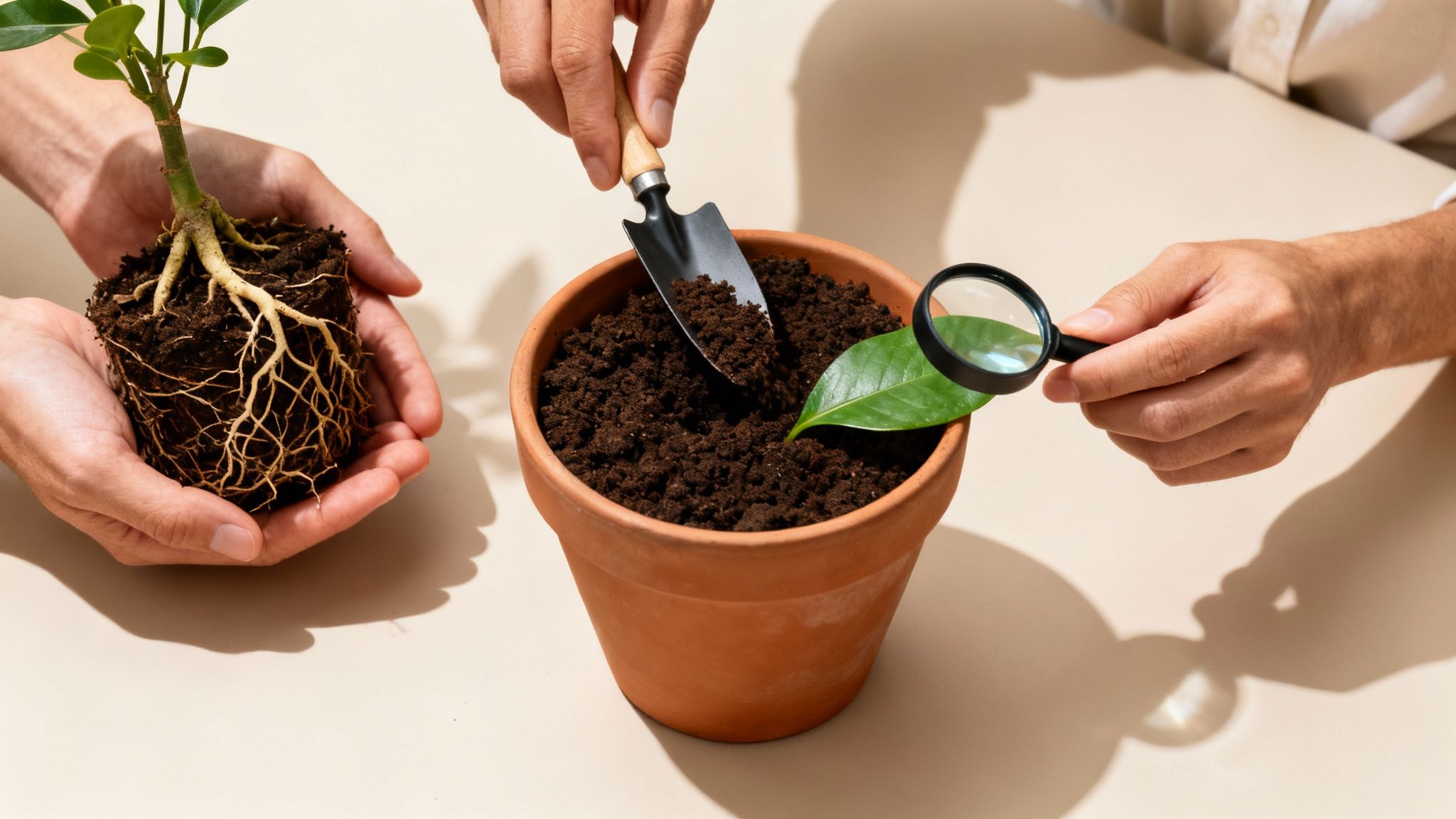
Every beautiful garden starts with a solid foundation, and that foundation is the soil. This certificate really drills down into understanding and preparing the ground for healthy, long-term growth. You will definitely get your hands dirty as you learn the practical techniques to turn a boring patch of dirt into a thriving garden bed.
This involves mastering tasks like:
- Conducting basic soil tests to figure out its pH and composition.
- Preparing garden beds for planting, which includes clearing weeds, cultivating the soil, and adding the right organic matter.
- Installing simple irrigation systems to make sure plants get watered consistently and efficiently.
You’ll also learn the art and science of planting and transplanting. This means knowing how to handle delicate seedlings without stressing them, how to space plants correctly for optimal growth, and the best techniques for moving established shrubs or trees without damaging them. These are the core construction skills every horticulturist relies on. For instance, you can dive deeper into caring for specific plant families, like learning how to look after various types of Australian native ferns.
This qualification is designed to give you the practical confidence to not just maintain a garden, but to actively improve it. You'll learn to see a landscape not just for what it is, but for what it could become with the right care and knowledge.
Working Safely and Sustainably
Professional horticulture isn't just about plants; it's also about working safely and responsibly. A big chunk of your training is dedicated to Work Health and Safety (WHS) protocols that are specific to the industry. You’ll learn how to handle tools and equipment—from secateurs to whipper snippers—the right way to avoid accidents.
This focus on professionalism ensures you can step onto any worksite, whether it’s a public park or a private client's backyard, and operate with confidence. You’ll also be trained in sustainable practices, learning how to conserve water, reduce waste, and contribute positively to the local environment. This blend of practical skill, safety awareness, and sustainable thinking is what makes graduates of the Certificate II in Horticulture so valuable to employers across Australia.
Finding the Right Way to Study in Australia
Deciding what to study is only half the battle. Figuring out how you're going to study is just as crucial to your success, especially for a hands-on qualification like the Certificate II in Horticulture.
In Australia, there are a few different pathways you can take, and each one has its own rhythm and set of demands. The best choice for you really boils down to your lifestyle, your other commitments, and how you learn best.
Traditional routes, like heading to a TAFE campus, offer a very structured, face-to-face environment with a fixed timetable. This can be fantastic for people who thrive on routine and in-person interaction. But for a lot of us, that kind of rigidity just isn't realistic.
Exploring Your Study Options
Let’s break down the most common ways to earn your certificate so you can see which one actually fits into your life. The goal is to find a model that backs your ambitions without forcing you to put everything else on hold.
- Full-Time Study: This is the classic, all-in approach. You’ll be on campus several days a week, making your course the main event. It's the fastest way to get qualified, but it’s also the least flexible.
- Part-Time Study: A great middle ground. Part-time study spreads your coursework out over a longer timeframe, letting you juggle learning with a job or family. You’ll still need to show up for scheduled classes, though, whether that’s on campus or in a live online session.
- Self-Paced Online Study: This is by far the most flexible way to learn. With a good online provider, you get 24/7 access to all your course materials. You can study whenever and wherever it suits you—late at night, on your lunch break, or over a quiet weekend.
The Power of Flexible Learning
Think about a busy parent who wants to turn their passion for indoor plants into a side hustle. They have pockets of free time—an hour after the kids are asleep, a few hours on a Sunday—but they can’t just drop everything for a 9 am lecture on a Tuesday.
For them, a self-paced online horticulture course isn't just a convenience; it's the only way forward. This kind of flexibility empowers people to chase new skills without having to completely upend their lives.
This model of learning is built for the real world, where life is unpredictable. It acknowledges that you have other priorities and gives you the tools to fit your education around them, not the other way around.
A common worry with online study is missing out on practical experience. It’s a valid concern. However, the best providers have designed their courses to bridge that gap. A quality Certificate II in Horticulture will use detailed video demonstrations, practical assignments you can complete in your own garden, and project-based assessments that get you applying your knowledge in a real-world context. This makes sure you're not just memorising theory but actively building job-ready skills.
Why Accessible Education Matters Now
The demand for flexible learning isn't just about making life easier; it reflects a much bigger need in the Australian market. Enrolment data for foundational vocational courses has revealed a surprising gap.
According to the National Centre for Vocational Education Research, there are currently no enrolments or completions recorded for the Certificate II, III, or IV in Protected Horticulture. This highlights a major disconnect between traditional course delivery and what students actually need. You can discover more about these horticulture industry trends and statistics.
This is where accessible, practical alternatives become so vital. For busy Aussies looking to start a side business in areas like indoor plant styling or local garden maintenance, self-paced, ICOES-accredited courses fill a critical void. Providers like Prac Skills AU cater specifically to this need, offering a Certificate II in Horticulture tailored to Australian conditions with 24/7 access. It ensures that anyone with the passion has a clear pathway to gaining professional skills.
Your Career Path After Graduation

A qualification is only as good as the doors it opens. Completing your Certificate II in Horticulture is a huge achievement, but it's really the starting line, not the finish. Think of this certificate as your key to unlocking a whole range of entry-level roles across Australia's vibrant green industry, giving you a direct route from learning to earning.
The skills you've worked hard to gain are immediately useful, making you a great candidate for employers who need enthusiastic, knowledgeable people on their team. It’s your official entry ticket into a world where a passion for plants becomes your profession.
Landing Your First Horticulture Job
With your new qualification in hand, you're perfectly positioned to step into several foundational roles. These are the jobs where you’ll really cement your practical skills, get a feel for the industry, and start building a network of contacts.
Consider these roles your professional apprenticeship, where every day on the job teaches you something new.
- Nursery Assistant: You could find yourself in a retail or production nursery, helping customers choose the right plants, caring for stock, and learning the commercial side of things. It's a fantastic way to deepen your plant knowledge.
- Parks and Gardens Team Member: Fancy working on a larger scale? You could join a local council or private contractor maintaining public green spaces—planting, pruning, mowing, and keeping our parks beautiful.
- Landscape Gardener's Apprentice: Get your hands dirty assisting a landscaping team. You'll be involved in building new gardens from the ground up, from preparing soil and laying turf to planting trees and installing irrigation.
These roles are an excellent way to apply what you’ve learned in a supportive, real-world environment. The starting salary for these entry-level positions in Australia typically ranges from $50,000 to $60,000 per year, depending on your location and the specific employer.
The Entrepreneurial Path
The Certificate II in Horticulture doesn't just prepare you for a job; it can also be the launchpad for your very own business. The foundational skills you learn are perfect for starting a service-based side hustle that has the potential to grow into a full-time venture.
If you've got an entrepreneurial spirit, you could start thinking about ideas like these:
- Garden Maintenance Service: Offer regular weeding, pruning, and general upkeep for homes or small businesses in your local area.
- Indoor Plant Stylist: Help people and businesses choose, source, and care for indoor plants that will thrive in their space.
- Specialty Plant Grower: You could focus on a niche market, like growing organic herbs, native wildflowers, or rare succulents to sell at local markets or online.
Starting your own venture means you get to be your own boss and build a business that perfectly aligns with your passions within the horticulture world.
A qualification like the Certificate II in Horticulture can have a real, measurable impact on your employment prospects. It signals to the market that you have invested in professional skills, which often leads to better outcomes.
The data backs this up. Vocational Education and Training (VET) courses in Australia show a significant positive effect on employment. According to VET Student Outcomes data, the national employment rate for students jumps from 70.3% before starting a course to 82.7% after completion. That's a 12.4 percentage point increase across the top 100 courses, highlighting the direct link between training and getting a job.
As you start your search, it helps to stay organised. To efficiently manage all your applications and opportunities, you can learn to master your job search with a job application tracker.
A Launchpad for Future Growth
Perhaps the greatest value of this certificate is its role as a solid foundation. It's the first step on a much longer and more rewarding career ladder. Once you have a year or two of experience under your belt, you can start thinking about specialising or moving into more advanced roles.
This initial qualification opens up pathways to further study, like a Certificate III in Horticulture, Parks and Gardens, or Landscape Construction. These higher-level courses allow you to dive deep into areas like arboriculture (tree surgery), turf management, or garden design. By exploring the full range of horticulture courses available, you can map out a clear path for where you want to go next. Your career can grow and evolve right alongside the gardens you care for.
Understanding Course Costs and Funding
Deciding to pursue a qualification is a big investment in your future, so it’s completely normal to want a clear picture of what it’s going to cost. The financial side of earning a Certificate II in Horticulture can feel a bit tangled at first, but once you break it down, it’s much easier to navigate.
The price tag for your course can swing quite a bit depending on where and how you decide to study. Different training providers have their own ways of pricing things, so it pays to do a little homework and compare what’s actually included in the fee.
Comparing Provider Costs
When you start looking around, you'll find there are two main players in Australia: the traditional TAFE institutions and private online colleges. Each one handles its fees a little differently.
- TAFE Institutions: TAFE courses are often subsidised by the government, which is great because it can bring the upfront cost down for students who are eligible. The catch is that fees can sometimes be structured per unit, and you might find extra costs for materials or student services that weren't obvious in the headline price.
- Private Online Providers: These guys often roll everything into a single, all-inclusive price. That means your tuition, learning materials, and tutor support are all bundled into one straightforward fee. The transparency here is a massive plus because you won’t get hit with surprise costs down the track.
It’s so important to look past the initial number and ask what you’re really getting for your money. Does the price include 24/7 access to your course, genuine tutor support, and all the digital resources you'll need? Sometimes, a slightly higher all-inclusive fee ends up being better value and gives you much more peace of mind.
Exploring Government Funding and Subsidies
The good news is the Australian government is putting serious money into practical skills training, which is fantastic for anyone wanting to get into horticulture. This commitment is clear from the growing number of students jumping into government-funded Vocational Education and Training (VET).
Recent data shows a huge surge in these programs, with the number of students in government-funded VET climbing by 5.0% to 1,256,365 in 2023. While Certificate III courses get a lot of the attention, foundational qualifications like the Certificate II are a vital part of the picture, with around 118,170 enrolments. This strong public investment really shows how much value is being placed on qualifications that give you job-ready skills. You can dig into more of the numbers on Australia's VET student trends.
Depending on your personal situation and where you live, you might be eligible for government funding or subsidies that can dramatically slash the cost of your Certificate II in Horticulture.
These programs are set up to help people gain skills in industries where workers are needed. Your eligibility often comes down to things like your age, employment status, and whether you’ve studied before. It’s always worth checking your state government’s skills or training website to see what support you can get. Traineeships are another brilliant option, letting you earn while you learn, with your employer often covering your training costs.
Making Your Education Affordable
Even if you don't qualify for a subsidy, a good training provider knows that flexibility is everything. Many offer payment plans that let you spread the cost of your course over several months, which makes budgeting so much easier.
Keep an eye out for providers that offer no-deposit payment plans, as this gets rid of a major hurdle right at the start. By breaking the total cost into smaller, regular instalments, you can get started on building your new skills straight away without having to save up a big lump sum first. It’s an approach that makes professional development accessible to everyone, ensuring your financial situation doesn’t have to put your career ambitions on hold.
Got questions about the Certificate II in Horticulture? You're not alone. Let's walk through some of the most common queries people have before they jump in. Getting these answers sorted can make all the difference.
Do I Need Any Experience to Enrol?
Not at all. This qualification is specifically designed as the perfect entry point into the industry. Think of it as the ground floor—it’s built for complete beginners who have a love for plants but haven't had any formal training or on-the-job experience yet.
How Long Does an Online Course Usually Take?
One of the best things about learning online is the flexibility. You're in the driver's seat. Most students find a comfortable rhythm and finish their Certificate 2 in horticulture within 6-12 months while studying part-time, but there's no pressure. You can power through it faster or take your time to fit it around your life.
Is an Online Certificate Respected by Employers?
Absolutely. What employers really care about are the skills you can bring to the job. A properly accredited online certificate, especially one recognised by bodies like ICOES and offering CPD points, is a clear signal of your dedication and knowledge. It puts you on solid footing as a credible candidate for entry-level roles anywhere in Australia.
An accredited online qualification tells employers two crucial things: you have the discipline to learn on your own, and you've mastered the specific, practical skills they need on day one.
What Kind of Support Is Available for Online Students?
You're never just left on your own. Good online course providers have solid support systems in place to make sure you succeed. This usually means you can reach out directly to expert tutors with your questions, get technical help when you need it, and often connect with a community of other students to share tips and experiences.
Ready to grow your passion for plants into a real career? At Prac Skills AU, our self-paced, ICOES-accredited Certificate II in Horticulture is built for busy Australians just like you. Start whenever you like, get 12 months of 24/7 access, and build the practical, job-ready skills that employers are looking for. Enrol today and start your journey at https://www.pracskills.com.au.