February 3, 2026
.webp)

Australian Accredited Online Courses A Practical Guide
Confused about Australian accredited online courses? This guide clarifies AQF, RTOs, and CPD to help you choose a quality course and advance your career.
Career Development
minutes
Diving into the world of online courses in Australia can feel a bit like navigating a maze. But if there’s one keyword that acts as your trusty map, it’s accredited. Think of Australian accredited online courses as qualifications that have earned an official stamp of approval, either from government bodies or key industry groups. It’s the quality seal that tells you a course is legitimate, valuable, and a smart investment in your career.
Finding Your Way in Australian Online Education

With a sea of online providers out there, that single word—‘accredited’—becomes your most reliable guidepost. It’s what separates a genuinely valuable qualification from just another piece of paper. This is especially true if you’re a busy professional or an aspiring entrepreneur needing practical, real-world skills that employers and clients will actually respect.
Accreditation is basically a promise. It signals that a course isn’t just a random collection of videos and PDFs but a properly structured learning experience that meets a recognised standard. My goal here is to demystify all of this for you. We’ll break down what the different types of accreditation mean, show you how to check a provider’s claims, and give you a practical checklist to pick a course that genuinely moves your career forward. It also helps to understand the different platforms for selling online courses, as this gives you a peek behind the curtain at how these educational products are built and delivered.
What This Guide Covers
Whether you’re gunning for a promotion, planning a complete career change, or getting ready to launch your own business, getting your head around the system is vital. This guide is all about practical outcomes—no fluff.
Here’s what we’ll walk through:
- Understanding Accreditation Types: We’ll explain the key differences between government and industry accreditation so you know what you’re looking at.
- Verifying Course Legitimacy: You'll learn simple, quick steps to check if a course's claims of being ‘accredited’ are actually true.
- Making the Right Choice: I'll give you a straightforward checklist to help you confidently pick a course that’s perfectly tailored to your goals.
This no-nonsense approach will help you cut through the noise and find quality Australian accredited online courses that deliver real value. For a broader look at where to find these courses, our guide on online learning platforms in Australia is a great next step.
Understanding the Two Worlds of Accreditation
When you start digging into Australian accredited online courses, you'll quickly discover that the word ‘accredited’ isn’t a one-size-fits-all label. It actually splits into two very different worlds, each serving a unique purpose for your career. Getting this difference right is probably the most important step in picking a course that actually helps you get where you want to go.
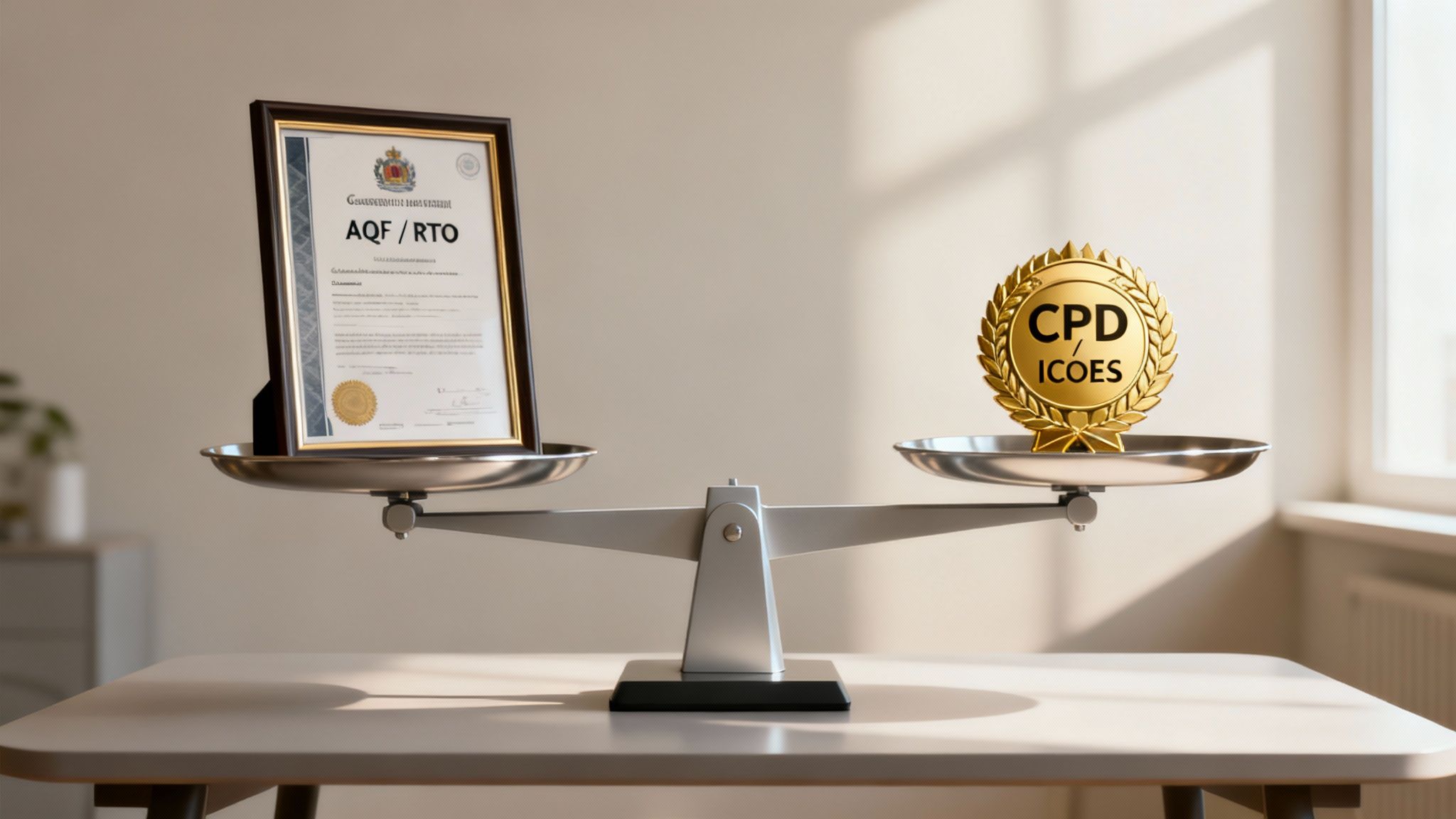
Think of it like this: you’ve got the official, government-backed system on one hand, and the specialised, industry-focused system on the other. Both are valuable, but they unlock completely different doors. Mixing them up could send you down the wrong path, so let’s break down exactly what each one means for you.
Government Accreditation: The National Passport
First up, there’s government accreditation. This is the formal, heavy-hitting system that’s nationally recognised and managed by official bodies like the Australian Skills Quality Authority (ASQA). Courses that fall into this category are part of the Australian Qualifications Framework (AQF)—the same framework that covers everything from a Certificate I all the way up to a PhD.
An AQF qualification is like a national passport for your education. It’s standardised, which means it’s understood and accepted by all universities and formal training providers (known as Registered Training Organisations or RTOs) right across the country.
An AQF qualification is your go-to if you need a clear stepping stone to higher education, require a specific licence to work in a regulated field (like childcare or electrical trades), or simply want a qualification that any employer in Australia will instantly recognise and understand.
This is the path for formal career progression and university credits. It guarantees that what you’re learning has passed a series of tough checks for content, delivery, and how you're assessed.
Industry Accreditation: The Specialist Badge of Honour
On the other side of the coin, we have industry and professional accreditation. This isn't about fitting into a broad national education system. Instead, it’s all about proving your skills are current, practical, and respected within a very specific field.
You can think of this type of accreditation as a specialist badge of honour. It's awarded by professional bodies or industry groups like Continuing Professional Development (CPD) or the International Council for Online Educational Standards (ICOES). It tells employers and clients that you've invested in up-to-the-minute knowledge that your industry values right now.
This is the perfect choice for:
- Upskilling: Quickly learning new, hands-on skills to get better at your current job.
- Side Hustles: Building credibility and earning trust with clients for a new venture, like dog grooming or social media management.
- Professional Development: Ticking the box on annual requirements to keep your professional membership or standing active.
These courses are usually more targeted, flexible, and laser-focused on job-ready skills rather than academic theory.
Government vs Industry Accreditation: What It Means for You
So, how do you decide which path is right? This table breaks down the key differences to help you match the accreditation type to your career goals.
Ultimately, the "best" accreditation depends entirely on your personal and professional goals. One isn’t better than the other—they just serve different purposes. Now, let’s look at how you can verify these claims and make sure a course is everything it promises to be.
Translating the Accreditation Alphabet Soup
When you start digging into online courses in Australia, you’ll quickly find yourself swimming in a sea of acronyms. RTO, AQF, CPD, CRICOS—it can feel like trying to crack a secret code. But don't worry, it's not nearly as complicated as it first appears.
Think of these acronyms as different kinds of quality checks, each designed for a very specific purpose. Getting your head around what they actually mean is the secret to matching a course to your career goals, making sure you’re putting your time and money in the right place.
RTO and AQF: The National Standard
A Registered Training Organisation (RTO) is a provider that’s been officially approved by the Australian government to deliver nationally recognised training. These courses all slot into the Australian Qualifications Framework (AQF), which is the same system that covers everything from a Certificate II right up to a university degree.
So, if you spot a course offered by an RTO that leads to an AQF qualification, you know it’s a formal, portable credential. This is the gold standard if you’re looking for a qualification for a licensed trade, a direct pathway to university, or a certificate that any employer across Australia will recognise in a heartbeat.
CRICOS: The Key for International Students
You might also come across CRICOS, which stands for the Commonwealth Register of Institutions and Courses for International Students. This accreditation is an absolute must-have for one specific group: international students who need a student visa to study here in Australia.
For most Australians studying online from within the country, CRICOS won't be a major factor. However, seeing it listed is often a good sign. It signals that a provider has met the tough government requirements needed to enrol overseas students, which usually points to high-quality standards and solid administrative processes.
ICOES: Global Recognition for Practical Skills
The International Council for Online Educational Standards (ICOES) offers a different flavour of validation. It’s not a government body, but an international organisation that accredits courses based on the quality of their content and the provider’s ethical standards.
An ICOES-accredited course is perfect for building practical skills you can use right away, especially if you're starting a new business or a side hustle. For example, a new dog grooming business owner can use an ICOES certificate to build instant trust and show clients they've invested in professional, high-quality training. It’s a global stamp of approval for your expertise.
CPD: Keeping Your Skills Current
Continuing Professional Development (CPD) is all about lifelong learning. Many professions—from massage therapy to accounting—require their members to clock up a certain number of CPD points or hours each year to keep their license or professional standing.
A CPD-accredited course is your ticket to staying relevant and compliant in your field. It proves you are actively maintaining and enhancing your skills, which is highly valued by employers and industry bodies.
Australia's online education scene is packed with options, from short certificates to full degrees. The Statistical Society of Australia notes that many programs, including short courses spanning just 10 to 14 weeks, hold accreditation, making them perfect for professionals needing to upskill quickly. You can even explore a range of accredited short courses available through top Australian universities.
Understanding these different labels helps you choose the right tool for the job. You can also get a much deeper understanding by reading our detailed guide that answers the question, "what is CPD accreditation?" and how it applies to your career.
How to Verify a Course Is Genuinely Accredited

A provider’s website might be covered in impressive-looking logos and bold claims, but it always pays to be a healthy sceptic. Trust is good, but verification is better—especially when your time and money are on the line.
Fortunately, checking if a provider’s claims are legit is much easier than you might think. Think of this as a quick due diligence checklist for your educational investment. A few minutes spent checking official sources can save you from a massive headache later, ensuring the qualification you earn is genuinely recognised.
Checking Government Accreditation
For any nationally recognised training—the kind delivered by Registered Training Organisations (RTOs)—there is one single source of truth you can rely on: training.gov.au. This is the Australian government’s national register for all things vocational education.
Here's how to check in three simple steps:
- Find the Provider’s RTO Number: Every legitimate RTO must display its unique registration number on its website. You’ll usually find it in the footer or on an 'About Us' page.
- Head to training.gov.au: This is the official database for every RTO and nationally recognised qualification in Australia.
- Search the Database: You can search by the provider's name, but using their RTO number is the quickest way to get a direct hit.
If the provider shows up, you can click on their name to see their registration status, contact details, and, most importantly, the exact list of qualifications they are approved to deliver.
Verifying Industry Accreditation
Checking industry bodies like CPD or ICOES works a little differently, as there isn't one central database. But the process is just as straightforward. Most reputable accrediting bodies keep a public directory of their approved providers on their own websites.
Don’t just trust a logo on a course provider’s page. Go directly to the accrediting body's website (e.g., the CPD Standards Office or ICOES) and use their search function to confirm the provider is listed.
This simple check confirms the relationship is current and legitimate, not just a logo they've copied and pasted.
Red Flags to Watch Out For
As you do your homework, keep an eye out for these common warning signs. Spotting them early can help you steer clear of scams and low-quality courses that won't get you where you want to go.
- Vague Claims: Watch for fuzzy language like "nationally approved" or "fully certified" without mentioning a specific accrediting body like ASQA or an RTO number. Real accreditation is specific.
- Logos Without Links: If a provider displays a CPD or ICOES logo, it should ideally link back to their official profile on the accreditor’s website. A static, unclickable image is a bit of a warning sign.
- No RTO Number in Sight: If a provider claims to offer AQF qualifications (like a Certificate or Diploma), they must have an RTO number. If you can’t find it anywhere on their site, that’s a major red flag.
- Hesitancy to Provide Details: Ask a provider for their registration details. If they get evasive or can't give you a straight answer, it's best to walk away. Legitimate providers are proud of their accredited status and will share it freely.
Choosing the Right Course for Your Career Goals

Knowing the difference between accreditation types is a great start, but the real magic happens when you connect that knowledge to your own ambitions. Let's be honest, choosing the right course isn’t about ticking a box or finding the single “best” accreditation out there. It’s about finding the perfect fit for your specific career path.
This means asking some sharp questions before you even think about hitting that ‘enrol’ button. A solid decision-making framework helps you cut through the marketing noise and pick a course that will actually deliver, whether you're looking to upskill, launch a new business, or just professionalise a passion you love.
Questions to Ask Before You Enrol
First things first: what's your end game? The ideal course for a tradesperson who needs a formal licence to get on-site is a world away from what a creative entrepreneur needs to build trust with their first clients.
Here are the critical questions to ask yourself to get clear on what you really need:
- What’s my main goal here? Are you chasing a formal AQF qualification (like a Certificate IV) because a job application demands it or you're planning a pathway to uni? Or do you need industry recognition (like CPD points) to show clients you're serious?
- Is this course actually relevant to Australia? Does the content cover our local market conditions, regulations, and industry standards, or is it just generic material that could apply anywhere?
- Does the learning style suit my life? Can I study at my own pace, whenever I can grab a spare hour? Or are there fixed lecture times I have to log into? For most busy Australians, that flexibility is a deal-breaker.
This kind of focused, practical learning is exactly what small business owners and side hustlers need—real results without having to commit to years of study.
Matching Accreditation to Your Ambition
Let's make this real. Here’s how different career paths call for different types of australian accredited online courses.
Scenario 1: The Small Business Owner
A café owner wants to get savvy with digital marketing. They don’t need a university degree; they need practical skills they can use tomorrow. An ICOES or CPD-accredited course in social media marketing or SEO is perfect here. It delivers job-ready skills and a certificate to add a professional touch to their website and LinkedIn profile.
Scenario 2: The Pet Sitter
Someone’s turning their love for animals into a proper pet-sitting business. An official AQF qualification is probably overkill. But an industry-recognised certificate in pet first aid or animal care—accredited by a body like ICOES—builds huge trust and credibility with nervous pet owners. You can explore plenty of online certificate courses in Australia that hit this practical sweet spot.
Scenario 3: The Creative Side Hustler
A talented photographer is launching a side gig. They need to build authority and attract those crucial first clients. A CPD-accredited course in professional photography or business for creatives gives them specialised knowledge and shows a commitment to their craft that clients will notice and value.
When you start with your end goal and work your way back, you can confidently pick a course with the right kind of accreditation to get you where you want to go.
Your Questions About Accredited Courses Answered
Even after breaking down the different types of accreditation, a few common questions always seem to pop up. Think of this as your practical FAQ section, designed to clear up any lingering doubts and give you the confidence to choose the right Australian accredited online courses for your specific situation.
We’ll tackle some of the most frequent queries we hear, providing clear, straightforward answers to help you make a fully informed decision.
Are Accredited Courses More Expensive?
Not necessarily. It’s easy to assume ‘accredited’ automatically means ‘expensive’, but that’s not always the case. While a government-accredited AQF qualification from an RTO often involves a higher investment due to its formal nature and rigorous compliance standards, this isn’t a universal rule.
The price of any course is influenced by a lot of factors, like the depth of the content, the level of instructor support, and the provider's general overheads.
Industry-accredited courses, like those recognised by CPD or ICOES, can be very affordable. They're often designed for targeted upskilling, which means they can deliver a huge amount of value without the same cost structure as a multi-year diploma.
The key is to think in terms of value, not just price. A slightly more expensive course that is highly regarded by your industry and helps you land a better job or more clients is a far better investment than a cheap, unrecognised one.
Always compare what’s included—like tutor support, how long you have access, and the learning materials—before you let the price tag make the decision for you.
Do Employers Prefer One Type of Accreditation?
This completely depends on the employer and the industry. There's no single answer, which is exactly why getting clear on your career goal first is so important.
For some roles, a specific AQF qualification is non-negotiable. You can’t work in early childhood education or many trades without a formal Certificate III or IV from a registered provider. In these fields, employers won’t even look at your application without it. It’s a mandatory ticket to the game.
However, in many other industries—especially fast-moving ones like digital marketing, creative arts, or wellness—employers are often more interested in your practical skills and your commitment to professional development. For these roles:
- A portfolio of work often speaks louder than a formal qualification.
- Industry-recognised certificates (like those from CPD or ICOES) demonstrate that your skills are current and relevant.
- Proof of continuous learning shows you’re proactive and dedicated to your craft.
The best approach? Go look at job descriptions for the roles you’re actually interested in. See what qualifications they mention and tailor your educational choices to match what the market is asking for.
Can I Get University Credit for My Course?
This is where the distinction between government and industry accreditation becomes crystal clear. Generally, only nationally recognised AQF qualifications delivered by an RTO have the potential to earn you credit towards a university degree. This is because they all exist within the same overarching educational framework.
Industry-accredited courses, while incredibly valuable for skills, aren't typically designed for university credit pathways. Their strength lies in practical application and immediate employability rather than academic progression.
That said, the path to higher education is becoming much more flexible. Since 1993, Open Universities Australia has seen over 540,250 students enrol in university courses through its platform, with many courses delivered entirely online without needing an ATAR. You can learn more about the growth of online university access in Australia. This just goes to show how much alternative pathways into uni are being embraced.
At Prac Skills AU, we specialise in practical, industry-recognised online courses that are designed to build your skills and confidence quickly. Explore our career-focused courses today and start your journey towards a new side hustle or a more rewarding career.