February 3, 2026
.webp)

What Is CPD Accreditation a Guide to Professional Development
Understand what is CPD accreditation and why it matters. This guide explains CPD points, accredited courses, and how they boost your career in Australia.
Career Development
minutes
Think of CPD accreditation as the professional world's version of a 'quality seal'.It’s a formal process that verifies a training course or learning activity meets high educational standards, confirming it’s well-structured, genuinely relevant, and recognised by the industry.
What Is CPD Accreditation Really?

Let's use an analogy. Imagine you're choosing a restaurant for a special occasion. You could pick any place, but seeing a five-star food safety certificate in the window gives you immediate confidence. You know the kitchen meets rigorous standards for hygiene, quality, and consistency.
CPD accreditation does exactly that for your education. It tells you that a course isn't just a random collection of information but a carefully designed learning experience that’s been put through its paces by an independent accrediting body.
These organisations assess everything—the course content, the learning objectives, the structure, and the qualifications of the instructors—to make sure it delivers real value. So, when a course is accredited, you know you’re investing your time and money wisely in training that’s credible, effective, and up-to-date.
The Currency of Professional Growth
The most common way to measure your progress is through CPD points or hours. Think of these as the currency of your professional growth.
Every point or hour you earn is verifiable proof that you’ve actively engaged in learning that sharpens your skills and expands your knowledge. It’s a clear, standardised system that helps you (and your industry body) track your commitment to staying current.
By collecting CPD points, you're not just ticking a box for compliance. You're building a tangible record of your dedication to professional excellence, which can be a game-changer for career advancement, maintaining memberships, or renewing your professional licence.
A quick way to understand the moving parts of accreditation is to break them down.
CPD Accreditation at a Glance
This framework ensures that every accredited course you take is a meaningful step forward in your career.
Why It Matters in Australia
In Australia, CPD accreditation is a big deal across countless industries. For some, like nurses, engineers, and accountants, meeting annual CPD requirements is mandatory to keep their registration. But it’s just as valuable for freelance designers, business consultants, or even pet sitters who want to formalise their skills and stand out from the crowd.
Accreditation provides a reliable benchmark for quality that everyone can trust.
For professionals in fields like psychology, where staying on top of new research and techniques is crucial, understanding the nuances of ongoing education is key. It’s worth exploring different study pathways, like those available when you study psychology online, to see how accredited courses can fit into your career plan.
Ultimately, choosing an accredited course sends a powerful message. It tells clients, employers, and your peers that you are serious about maintaining the highest professional standards, giving you a clear advantage in a competitive market.
How the CPD System Works in Australia
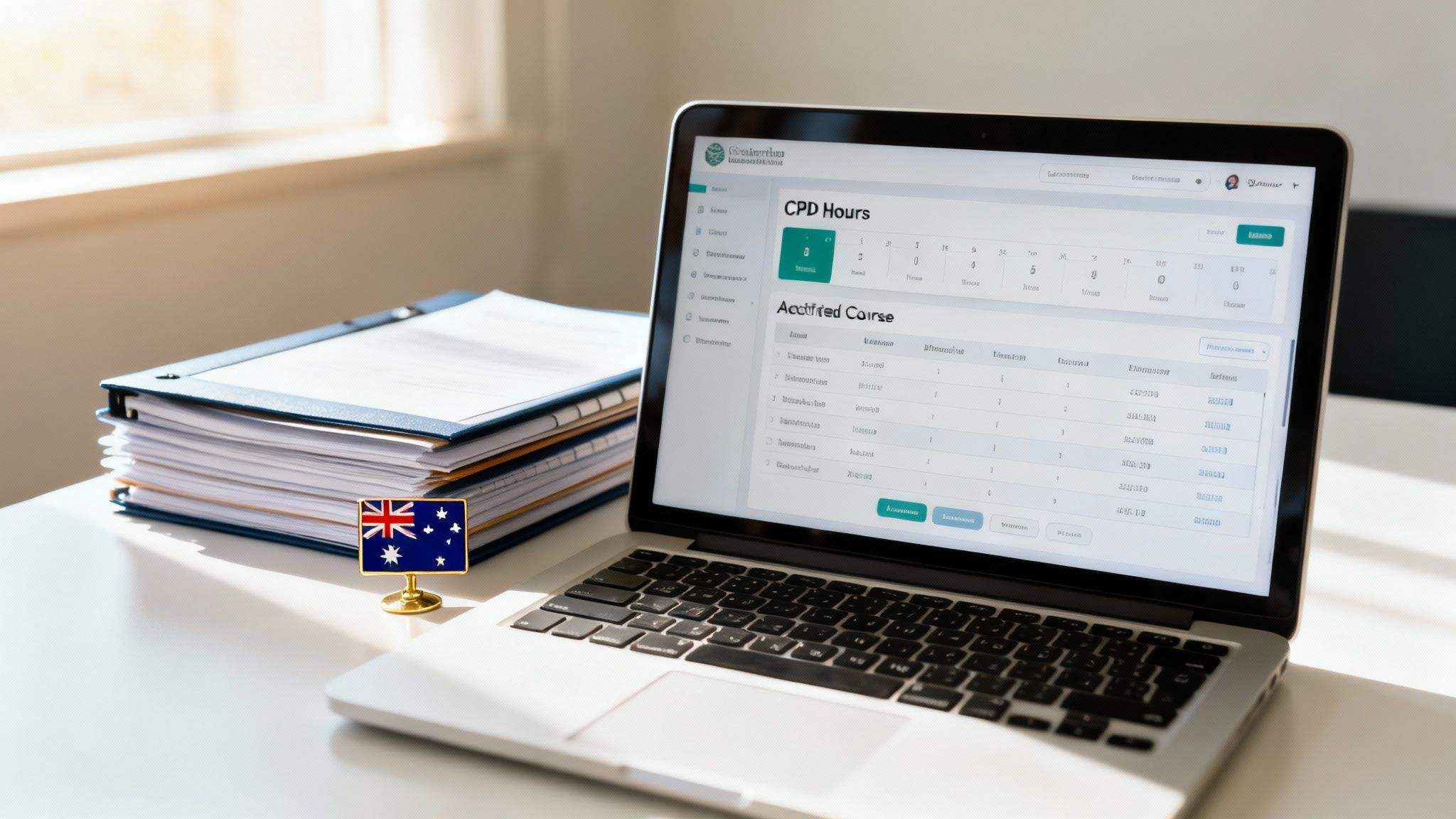
Australia’s approach to Continuing Professional Development is anything but casual. It’s a highly structured framework built to ensure professionals across every sector are at the top of their game. The core idea is simple: learning shouldn't stop when you graduate. It's an ongoing commitment to being the best you can be.
This organised system is all about regulating quality and building public trust. It’s what gives you confidence that the accountant, builder, or therapist you hire has skills that are current and meet tough national standards. This structure is exactly why an Australian CPD accreditation carries so much weight—it’s a clear signal that a course has met these rigorous local benchmarks.
For small business owners or anyone looking to switch careers, getting your head around this system is a game-changer. When you invest in courses that fit within this framework, you're backing yourself with learning that's recognised and respected right across the country, giving your skills a credible, formal edge.
The Shift to a More Rigorous System
Lately, Australia's CPD landscape has been evolving, moving away from flexible, points-based models to more clear-cut, hours-based requirements. This change reflects a nationwide push for greater accountability and more meaningful professional learning, highlighting the importance of what is cpd accreditation in today's professional world.
A perfect example of this shift kicked off on 1 January 2023. The Medical Board of Australia overhauled its Registration Standard, now requiring all registered doctors to join an accredited ‘CPD Home’ to stay registered. This was a major move away from the old points system to a strict new rule: every doctor must now complete a minimum of 50 CPD hours annually across three core learning areas. You can explore the details of this new standard to see just how seriously professional development is being managed.
This isn’t just about ticking a box and logging hours. It’s about engaging in a structured program with a mix of learning activities, ensuring your development plan is well-rounded and comprehensive. It's a clear sign that Australian industries are formalising CPD to guarantee genuine, ongoing skill enhancement.
Understanding the CPD Home Concept
The idea of a 'CPD Home' is central to this modernised approach. It’s an organisation accredited to manage and track a professional’s CPD, acting as a central hub for their entire learning journey.
Think of it as a personal fitness tracker for your career. Instead of logging workouts, you’re logging courses, workshops, and other learning activities. Your CPD Home provides the platform, guidance, and verification to make sure you meet your annual requirements without any fuss.
A CPD Home isn't just a record-keeper; it's a partner in your professional growth. These organisations help professionals plan their learning, find relevant accredited courses, and maintain an official record that proves their compliance and dedication to their craft.
Bodies like the Royal Australian College of General Practitioners (RACGP) are prime examples of a CPD Home in action. They give their members resources, track their hours, and check that all learning activities align with the standards set by the national medical board. This organised approach makes managing professional development straightforward and transparent, reinforcing the integrity of the whole system.
The Tangible Benefits of Accredited Courses

It’s one thing to understand how CPD works, but the real question is: what does an accredited certificate actually do for you? The answer is simple. Choosing an accredited course isn’t just about learning; it’s a strategic move that delivers clear, practical advantages.
This is true whether you're climbing the corporate ladder or building your own small business from the ground up.
For professionals, an accredited qualification is a powerful signal to employers. It’s verifiable proof of your skills, giving your resume an instant boost and building their confidence in your abilities. This formal recognition can be the deciding factor that pushes your career forward and opens doors to new opportunities.
If you’re a small business owner in Australia, the benefits are even more direct. Accreditation builds immediate trust with potential clients. It shows you're committed to professional excellence and aren't cutting corners—a serious competitive edge in a crowded market.
Turning Accreditation into Client Trust
Imagine you run a local pet-sitting business. An accredited certificate in ‘Canine First Aid’ does more than just teach you valuable skills—it becomes a powerful marketing tool. You can display the accreditation logo on your website and flyers, instantly reassuring clients that you’re a qualified, responsible professional they can trust with their beloved pets.
This principle applies across every industry. Think of a freelance artist with an accredited certificate in ‘AI Art Monetisation’. That qualification tells potential clients their skills are current, verified, and aligned with modern industry practices, making them a much more attractive choice for projects.
Accreditation transforms your skills from a personal asset into a public statement of quality. It provides the external validation that turns prospective customers into paying clients by demonstrating a commitment to high standards.
Beyond just ticking a box for learning hours, accreditation ensures providers follow rigorous processes for online course quality assurance done right, giving you complete confidence in the content.
A Clear Return on Your Investment
Investing in accredited training isn't just another expense. It's a direct investment in your professional credibility and your business’s growth, and the advantages translate into real-world outcomes that build momentum for your career.
Here’s exactly how it pays off:
- Boosts Professional Credibility: Your skills are validated by a respected third party, removing any doubt about your expertise.
- Increases Earning Potential: Recognised qualifications often lead to better job roles, promotions, and the ability to charge higher rates for your services.
- Builds Client Confidence: For entrepreneurs, it’s a clear sign of professionalism that helps attract and retain customers who value quality.
- Meets Industry Requirements: In many fields, accredited CPD is necessary for maintaining professional memberships, licenses, or insurance.
For those in helping professions, accredited learning is especially powerful. For example, completing an online certificate in mental health provides you with verifiable skills that are essential for building trust and proving your commitment to ethical, high-quality practice.
Ultimately, this formal recognition is what separates dedicated professionals from casual hobbyists in the eyes of both employers and clients.
Who Are the Key Accrediting Bodies?
Think of CPD accreditation as a promise of quality. But who exactly makes that promise? The answer lies with accrediting bodies—independent organisations that act as the gatekeepers of educational standards.
These institutions aren't affiliated with the course provider. Their sole purpose is to conduct a rigorous, impartial review of learning materials. They meticulously assess a course’s content, structure, and learning outcomes to make sure it provides genuine value.
This independent verification is what confirms that a course is more than just a collection of information. It's a structured educational experience designed to meet professional benchmarks. Without these bodies, the term 'accredited' would be meaningless. When you see a course is accredited, it means a respected third party has given it a formal seal of approval, building trust and giving real weight to your qualification.
Global and Australian Accreditors
The world of CPD accreditation is a mix of international and local players, each with its own area of focus. Some operate globally, offering a broad standard of quality recognised in multiple countries, while others are specific to certain industries or regions, like Australia.
This blend ensures professionals have access to a wide range of high-quality learning opportunities, whether they need skills with international relevance or training tailored to specific Australian regulations and market needs.
A few key players you might come across include:
- The CPD Certification Service: An independent global body that accredits thousands of courses, events, and e-learning programs across all professional sectors. Their logo is a widely recognised mark of quality assurance.
- ICOES (International Council for Online Educational Standards): This body specialises in assessing online learning providers, making sure their digital courses meet high standards for both content and delivery.
- Industry-Specific Regulators: In Australia, many professions have their own governing bodies that accredit CPD. For example, the Australian Medical Council (AMC) accredits organisations that provide professional development for doctors.
Prac Skills is proud to have our courses validated by respected institutions. You can learn more about our specific accreditations and partnerships to see how we align with these quality standards.
A Closer Look at Australian Standards
In Australia, the role of accrediting bodies is particularly vital for keeping professional standards high. A prime example of this was when new Medical Board standards took effect on 1 January 2023.
This change required all 136,742 registered doctors to join one of 21 AMC-approved 'CPD Homes' by the start of 2024. These doctors must now log 50 hours of specific learning activities annually. This move really highlights how central these bodies are in upholding professional excellence across the country.
How to Earn and Manage Your CPD Points

Earning CPD points isn't about jumping through administrative hoops. Think of it more like creating a clear roadmap for where you want to go in your career. The whole process is actually pretty straightforward: you find learning opportunities that fit your goals, complete them, and then log everything for official recognition.
Every accredited course, workshop, or webinar you finish is another entry in your professional portfolio, proving you’re committed to staying on top of your game. It’s this proactive approach that keeps your skills sharp and ensures you’re always meeting the latest industry standards.
The real key is managing this process well. If you can turn it from a once-a-year chore into a continuous, rewarding habit, you’ll build a powerful testament to your professional journey.
Create Your Professional Development Plan
First things first, you need a Professional Development Plan (PDP). Don't worry, this isn't some complex fifty-page document. It's really just a simple strategy outlining what you want to learn and, more importantly, why. A good PDP helps you focus your time and energy on activities that will actually move the needle for your career.
Start by asking yourself a few honest questions:
- What new skills would help me in my role or business right now?
- Are there any obvious gaps in my knowledge I need to address?
- Where do I see myself in the long run, and what learning will help me get there?
Your answers will point you toward the right kind of accredited training, making sure every hour you invest is time well spent. If you're looking to earn your CPD points through online learning, a good online course platform comparison guide can be a huge help in finding the best fit for your learning style.
Logging and Tracking Your Progress
Once you’ve completed an accredited activity, the next step is absolutely crucial: log it. Keeping meticulous records is non-negotiable, especially if you have to report your hours to a governing body.
Keeping a clear and up-to-date log is your proof of compliance. It’s the official record that validates your efforts and secures your professional standing, providing peace of mind when it’s time for renewal or an audit.
Luckily, modern tools have made this so much easier. Many professional associations now offer online portals or apps where members can track their progress without any fuss.
Take Australia's system for its 136,000+ doctors, for example. Since January 2023, they've been required to log 50 hours a year through an accredited CPD Home. A major CPD Home like the RACGP specifies certain activity types that members track using tools like myCPD, which even automates uploading evidence. You can discover more about this structured CPD program to see how organised logging works in a real-world setting.
No matter how you track it, your log should always include these key details for each activity:
- Activity Title: The name of the course, webinar, or event.
- Provider: Who delivered the training (e.g., Prac Skills).
- Date of Completion: When you finished the activity.
- CPD Hours/Points: The number of accredited hours or points earned.
- Evidence: A copy of your certificate of completion or other proof.
Keeping these records organised and ready to go makes it easy to demonstrate your commitment to learning and meet any professional requirements with total confidence.
Your CPD Questions Answered
Even once you get your head around what CPD accreditation is, a few practical questions almost always come up. Let's tackle some of the most common ones to clear up any lingering confusion and help you make smart decisions about your professional learning.
Is CPD Accreditation the Same as a University Degree?
This is a fantastic question, and the answer really comes down to purpose.
Think of a university degree as building the foundation of a house. It’s the comprehensive, formal qualification that gets you into a profession in the first place, giving you the fundamental knowledge and broad theoretical base to start your career.
CPD accreditation, on the other hand, is like renovating and upgrading that house over time. It’s designed for professionals who are already in the field. Accredited courses deliver focused, specialised training to keep your existing skills sharp and up to date with the latest industry changes and techniques.
A university degree gets you in the door of a profession. A CPD-accredited certificate proves you’re committed to excellence once you’re inside.
Do I Need CPD If I Run My Own Business?
While it might not be a legal requirement for every entrepreneur, investing in CPD is one of the smartest moves a business owner can make. In a crowded market, that accredited certificate is a powerful tool for building immediate trust and credibility with your clients.
It signals that you’re serious about your craft and dedicated to upholding the highest professional standards. For many freelancers and small business owners, this formal recognition is also essential for securing memberships with professional associations or even maintaining liability insurance. It’s a direct investment in your business’s reputation and its future.
How Do I Know If a Course Is Genuinely Accredited?
Verifying a course’s accreditation is crucial. You want to be sure you’re investing your time and money in a quality program, not just empty promises. Luckily, it’s easier than you might think to spot a legitimate provider.
Here are a few simple checks you can run:
- Look for Official Logos: Reputable providers will proudly display the logos of the accrediting bodies that have given their courses the tick of approval, like the CPD Certification Service or ICOES.
- Check the Accreditor’s Website: Most accrediting bodies maintain a public database of approved providers. You can often head to their site and search for the training company directly to confirm they’re the real deal.
- Ask for an Accreditation Number: A genuinely accredited course will often have a unique reference or accreditation number. Don’t be afraid to ask the provider for this detail as proof.
These quick steps empower you to make confident choices, ensuring the qualification you earn holds real weight.
Are Online CPD Courses Recognised in Australia?
Absolutely. High-quality, accredited online courses are widely accepted and valued for CPD right across Australia, as long as they are relevant to your profession. What really matters is the quality and relevance of the training, not how it’s delivered.
Online learning offers incredible flexibility and accessibility, which is a perfect fit for the packed schedules of busy professionals and business owners. It allows you to gain valuable, industry-recognised skills without having to put your work or life on hold. Courses designed specifically for the Australian market also ensure the content aligns with local regulations and professional standards, making them a practical and respected choice for your development.
Ready to invest in your professional growth with courses that are practical, recognised, and built for the Australian market? Explore the accredited online courses at Prac Skills and find the perfect fit for your career goals. https://www.pracskills.com.au