February 3, 2026
.webp)
Psychology Study Online: Your Complete Australian Guide
Considering psychology study online in Australia? This practical guide helps you choose courses, understand accreditation, and launch a meaningful new career.
Career Development
minutes
Deciding to study psychology online is a fantastic way to get your head around human behaviour, offering a flexible and accessible path to some seriously valuable skills. Whether you're looking to level up in your current job, make a complete career pivot, or just dive into a topic you've always been fascinated by, online courses give busy Aussies a practical way forward. Think of this guide as your personal roadmap for navigating this rewarding field from start to finish.
Why Studying Psychology Online Is a Smart Move Right Now

There's a growing understanding across Australia that psychology skills aren't just for aspiring clinicians. Far from it. They're becoming essential life and professional skills that bring a huge amount of value to almost any industry you can think of. This surge in demand is a massive reason why so many people are now looking to study psychology online.
Consider this: according to insights from accredited training providers, nearly one in two Australians between 16 and 85 will experience a mental health disorder in their lifetime. That's a staggering statistic, and it shines a light on a massive societal need. With mental health awareness thankfully on the rise, platforms are responding by offering practical courses in mental health, psychology, and counselling that are actually designed to fit into a busy Aussie lifestyle. You can see more about the demand for these courses over at Training.com.au.
Skills for Every Career Path
The real magic of psychology is how its principles stretch far beyond the therapist's office. When you understand what drives human motivation, behaviour, and thought processes, you gain a serious advantage in a whole host of fields.
- Human Resources: An HR manager with a handle on psychological principles can navigate conflict resolution, boost team dynamics, and roll out employee wellness programs that actually work.
- Marketing and Sales: Imagine a marketer who gets cognitive biases. They can craft far more persuasive campaigns and build genuine, lasting customer loyalty.
- Leadership and Management: Any team leader can create a more supportive and productive work environment by applying the basics of organisational psychology.
This versatility is what makes an online psychology qualification such a powerful asset, whether you're climbing the corporate ladder or running your own show.
The best part about studying psychology online is how quickly you can apply what you learn. You could be reading about a concept like motivational interviewing one evening and putting it into practice in a team meeting the very next day.
Flexibility That Fits Your Life
Let's be honest, for many of us, the flexibility of online study is the biggest drawcard. Juggling work, family commitments, or a side hustle can make trekking to a physical campus seem completely impossible. Online learning just smashes that barrier to pieces.
You can genuinely study on your commute, late at night once the kids are finally asleep, or in dedicated blocks over the weekend. This self-paced approach puts you firmly in the driver's seat, letting you learn at a pace that actually works for your life, without having to drop your other responsibilities. It’s a truly empowering way to invest in your future, completely on your own terms.
Choosing Your Online Psychology Qualification
So, you’ve decided to study psychology online. Brilliant. But now you’re probably staring at a screen filled with a dizzying number of options, from weekend workshops to full-blown degrees. It's easy to get lost in a sea of course descriptions, so let’s cut through the noise and figure out which path is actually right for you.
The choice really boils down to three main pathways, and each one serves a very different purpose. Getting your head around these differences is the most important first step you'll take.
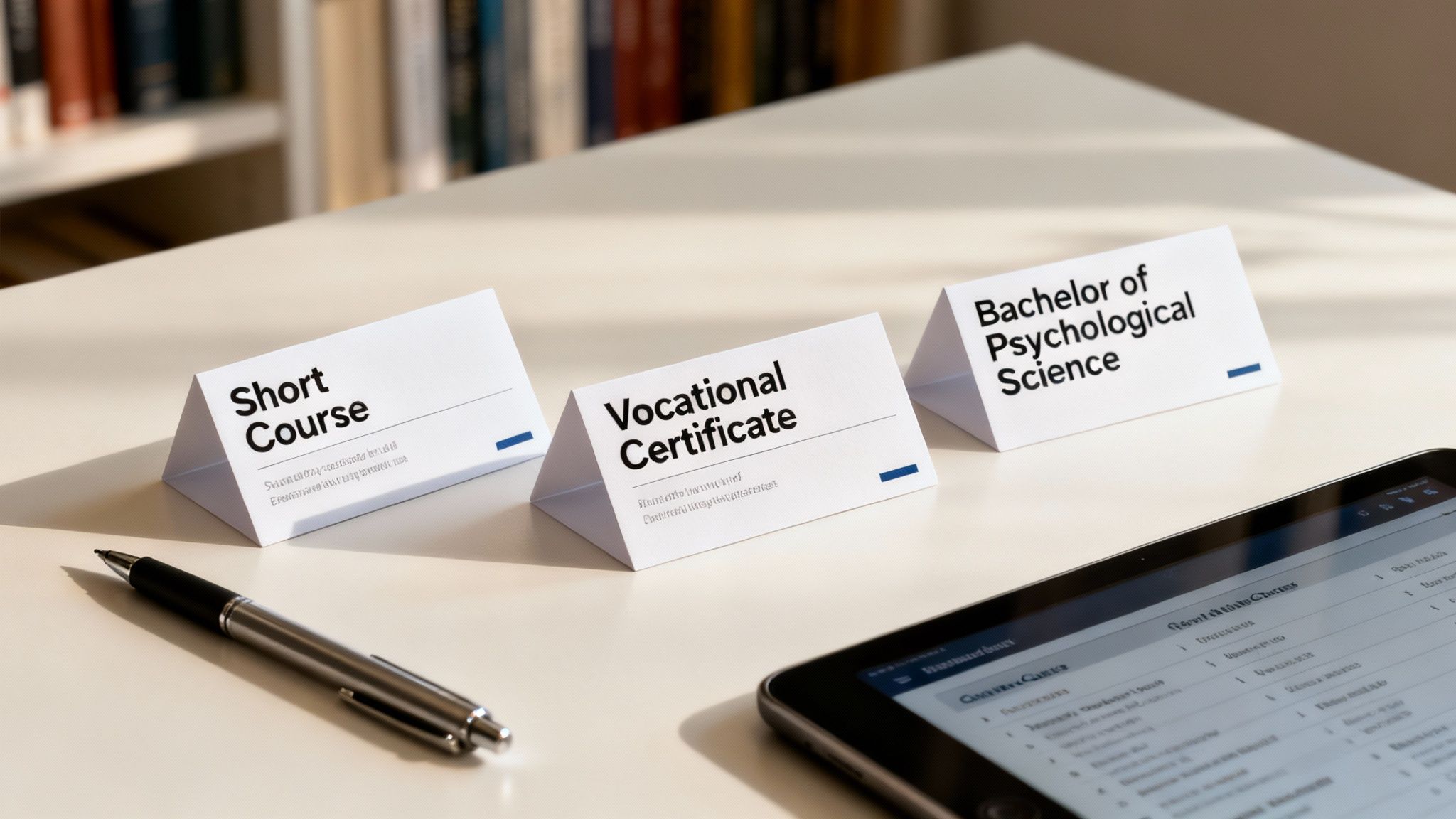
Short Courses and Bundles
Short courses are fantastic for dipping your toes in the water or for grabbing a specific skill you need right now. They're usually self-paced, pretty affordable, and you can knock one over in a few weeks or months.
Think of it this way: a crime fiction writer might enrol in a 'Criminal Psychology Bundle', not to become a forensic psychologist, but to add that chilling touch of realism to their next novel. Or a primary school teacher might take a short course on child development to get a better handle on classroom dynamics.
These courses are perfect for adding a specific tool to your professional kit or just satisfying a deep curiosity without the huge commitment of a formal qualification. If you're looking for specialised skills, our guide on child psychology courses is a great place to start.
Short courses offer a low-risk, high-reward way to test the waters. They help you confirm your passion for psychology before you invest significant time and money into a longer qualification.
Vocational Certificates
Sitting somewhere between a short course and a uni degree, you'll find vocational certificates, like a Certificate IV or a Diploma. These qualifications are all about getting you job-ready for specific support roles in the community services or mental health sectors.
They’re more structured than a short course and often have practical, hands-on components. If you see yourself working as a mental health support worker, a youth worker, or in a community outreach program, a vocational certificate gives you the foundational skills and industry-recognised credentials that employers are actually looking for.
University Degrees
Now, if your goal is to become a registered psychologist in Australia, a full university degree like a Bachelor of Psychological Science is the non-negotiable first step. There's no way around it. This is a rigorous, accredited pathway that takes a minimum of three years of full-time study.
This path is for those who are committed to the long haul—the professional journey of clinical practice, research, or academia. You'll dive deep into scientific principles, research methods, and the complex theories underpinning psychology.
And it doesn't stop there. After the bachelor's degree, you’ll need to complete postgraduate study and supervised practice. All up, you're looking at a journey of at least six years to gain registration with the Psychology Board of Australia.
To make things a little clearer, here’s a quick breakdown of how these options stack up against each other.
Comparing Online Psychology Study Paths
Ultimately, the "best" choice is the one that aligns with your career goals, your timeline, and your budget. Take the time to think about where you want to end up, and that will make choosing your starting point much easier.
Digging Into Accreditation and Course Quality
When you decide to study psychology online, you’re not just spending your time; you're making a serious investment in your future. That's why it's so important to look past the flashy course titles and get into what really counts: accreditation and genuine quality. The online learning space is massive, and frankly, not all courses are created equal.
One of the biggest points of confusion I see is what all the different accreditations actually mean, especially for us here in Australia. You’ll often find providers advertising certifications from bodies like ICOES (International Council for Online Educational Standards) or endorsements for CPD (Continuing Professional Development).
These are definitely valuable. They signal that a provider is committed to educational standards and has had its course structure and content delivery meet specific international benchmarks. For many roles in wellness, community support, or even just for upskilling in your current job, these industry-recognised certificates are exactly what employers are looking for.
But—and this is a big but—they are different from the accreditation you absolutely must have to become a registered psychologist.
Matching the Right Accreditation to Your Career Goal
If your ultimate ambition is to practise as a registered psychologist in Australia, the path is extremely specific and there are no shortcuts. You must complete a degree accredited by the Australian Psychology Accreditation Council (APAC). This is the one and only pathway recognised by the Psychology Board of Australia for registration.
Short courses, no matter how well-regarded or accredited by other bodies, simply do not count toward this formal pathway.
So, the very first question you need to ask yourself is: what is my end goal?
- Looking for industry-specific skills or a career boost? In that case, look for providers with strong industry recognition, like CPD endorsement. It's worth exploring the value of these partnerships to see what they mean for your qualification.
- Want to become a registered psychologist? Then your focus needs to be laser-sharp: find an APAC-accredited university degree. Nothing else will get you there.
What Real Quality Looks Like (Beyond the Certificate)
Accreditation is just one piece of the puzzle. The actual quality of your learning experience comes down to the course format and the support systems you have access to. A top-tier online psychology course offers solid tutor support, materials that actually keep you engaged, and a clear, easy-to-follow learning structure.
Before you even think about enrolling, get on the front foot and ask some direct questions:
- What are the tutors' qualifications? Do they have real-world industry experience?
- How can I get support? Is it via email, phone, or live chat? What are the typical response times?
- Can I see a sample lesson? I want to check out the quality of the videos and reading materials for myself.
A great online course shouldn’t feel like you’ve just been handed a PDF and left to figure it out on your own. Look for interactive elements, clear guidance, and accessible experts who can help you when you inevitably get stuck. That support system is often what separates a frustrating experience from a truly rewarding one.
Creating a Study Routine That Fits Your Life

Let's be honest: the biggest drawcard for studying psychology online is the freedom. But without a campus timetable locking you in, it’s entirely on you to create a routine. If you don't, your course can quickly become just another thing on the to-do list that never gets done. Success comes down to being intentional with your time and building a system that actually works for you, not against you.
Forget the old advice about cramming for hours on end. That’s a fast track to burnout, especially when you’re juggling work, family, or other commitments. Instead, think in short, focused bursts.
The Pomodoro Technique is an absolute game-changer for this. You study for 25 minutes, then take a five-minute break. It’s a simple but powerful way to keep your mind fresh and makes it so much easier to get started when you only have a small window of time. It means you can weave learning into the little pockets of your day—listening to a lecture on your commute, flicking through flashcards on your lunch break, or watching a video while dinner’s in the oven.
Design Your Ideal Study Space
Your environment has a massive impact on your ability to focus. You don’t need a dedicated home office, but you absolutely need a designated study nook. This could be a corner of the living room or even just a consistently clear space at the kitchen table.
The goal is to create a signal for your brain that says, "it's time to learn." Keep all your study materials organised in one spot, maybe in a box or on a specific shelf. When you sit down to study, have everything you need—laptop, notebook, headphones—within arm's reach. A clutter-free space really does help create a clutter-free mind.
Staying motivated without the buzz of a physical campus requires a different mindset. It's about creating your own momentum. Celebrate small wins, like finishing a module or acing a quiz. These little victories build confidence and keep you moving forward.
Staying Engaged and Motivated
Online learning can feel a bit isolating at times, so it's vital to plug into your course community. Jump into the student forums, find a study group on social media, or reach out to your tutors with questions. Just seeing that other people are on the same journey provides a powerful sense of accountability and makes you feel less alone.
A cornerstone of any psychology course is learning to think critically. You’re not just memorising facts; you’re learning to analyse them. It’s well worth exploring resources on how to improve your critical thinking skills by questioning assumptions and evaluating evidence from the get-go.
Ultimately, you need a learning strategy that is both effective and sustainable. For more ideas on how to make your study sessions count, check out our guide on ten science-backed learning strategies.
By mixing smart time management with a dedicated space and a proactive mindset, you can build a study routine that doesn't just fit into your busy life—it helps you thrive.
Turning Your Online Certificate Into a Career
So you’ve finished your online psychology course. That’s a massive achievement, but it’s really just the starting line. Now for the exciting part: turning that shiny new certificate and all your hard-earned knowledge into real-world opportunities. This is where your study transforms from an educational pursuit into a genuine career asset.
It’s easy to think an online certificate is just one thing, but it’s incredibly versatile. It can be the launchpad for a new side hustle, a powerful upgrade for your current job, or a solid stepping stone toward further university study. The key is to think strategically about how your new skills fit into the Australian job market.
Boosting Your Current Career or Business
One of the most immediate ways to use your qualification is to enrich what you already do. The principles of psychology aren’t confined to clinical settings; they are powerhouse tools in almost any industry you can think of.
Take a personal trainer in Melbourne, for example. With a certificate in wellness coaching, they can suddenly offer more holistic support to clients, tackling mindset and motivation alongside physical fitness. This not only gets better results for their clients but also carves out a new, premium service for their business.
Or think about an animal care professional. A course in animal psychology and behaviour gives them a much deeper understanding of the animals they work with. They can provide better care, manage challenging behaviours more effectively, and offer more insightful advice to stressed pet owners.
These are just a couple of examples. Your new skills can help you:
- Improve client communication by understanding their true motivations and barriers.
- Enhance your team leadership by applying principles of group dynamics and motivation.
- Create more effective marketing by genuinely understanding consumer behaviour.
The real value of a practical online certificate is its immediate application. You don't have to wait years to see a return on your investment; you can start integrating what you've learned into your work from day one, adding tangible value to your role or business.
Launching a Side Hustle or New Venture
For many people, an online psychology course is the first concrete step toward building something of their own. Your certificate can provide the foundational knowledge and credibility to launch a specialised service you’re passionate about.
Someone with a green thumb could combine their love of horticulture with a wellness certificate to offer therapeutic gardening workshops. A person with a background in HR could start a side hustle as a career coach, using their psychological insights to help people navigate their professional lives with more confidence. The possibilities are genuinely vast and are only limited by your creativity.
A Pathway to Further Study
Your online certificate can also be the perfect way to confirm your passion for psychology before committing to a multi-year, expensive university degree. It gives you a real taste of the subject matter and academic discipline, helping you make a much more informed decision about your long-term educational journey.
Plus, it serves as excellent evidence of your interest and dedication on a university application. It shows you've already taken the initiative to build your foundational knowledge.
The Australian job market shows a clear and growing demand for these skills. Here's a real eye-opener from local job data: psychologist roles are projected to grow to 35,100 by 2026, with strong growth flagged by Australian Labour Market Insights. This trend highlights why a psychology study online is such a smart move for ambitious Aussies, particularly through providers crafting career-focused paths in psychology and wellness. Find out more about the growing demand for psychology professionals in Australia.
Your Questions About Online Psychology Study Answered
Dipping your toes into the world of online psychology study is a big move, and it’s completely normal to have a few questions buzzing around. Let's tackle some of the most common ones head-on, so you can feel confident about taking that next step.
Can I Become a Registered Psychologist with a Short Online Course?
The short answer is no—but these courses are an absolutely brilliant starting point.
Becoming a registered psychologist in Australia is a serious commitment. It’s a tightly regulated path that involves a specific six-year accredited university journey, kicking off with a bachelor's degree approved by APAC (Australian Psychology Accreditation Council). There are no shortcuts here.
So, where do short online courses fit in? They are incredibly valuable for getting a solid foundation in a specialised area, like criminal or child psychology. They also offer industry-recognised certificates (like those with CPD or ICOES accreditation), which are fantastic for roles in wellness, community services, or HR.
Think of it as a low-risk way to test the waters and confirm your passion before you dive into a long-term degree.
Are Online Psychology Qualifications Respected by Employers?
This one really comes down to your career goals. If you're aiming to be a registered psychologist, employers will only look at candidates with those APAC-accredited university degrees. That’s just the industry standard, plain and simple.
But for a massive range of other roles? The answer is a huge yes.
Employers in fields like wellness coaching, human resources, marketing, and community support love the practical skills you get from quality online courses. The key is matching the right qualification to the job you want. A certificate in wellness coaching, for example, is far more relevant to a gym or personal training business than a theoretical university research paper.
The crucial takeaway is that "respect" is all about relevance. A high-quality online certificate from a provider like Prac Skills AU is designed to be immediately applicable, demonstrating your commitment and specific expertise in a chosen area to potential employers.
How Much Time Should I Realistically Commit Each Week?
Here’s the best part about self-paced online learning: you are in the driver's seat. Forget rigid university timetables—there are no set weekly hours. You make your study fit your life, not the other way around.
Some of our students block out a few solid hours every weekend. Others prefer to chip away with 30-minute sessions on their lunch break or during their commute. It’s not about a strict schedule; it's about consistent progress.
This flexibility is what makes it all work. It empowers you to learn in a way that feels sustainable and actually effective for you. If you ever feel the pressure mounting, remember there are fantastic online counselling resources tailored for students that can help you manage the demands of self-directed learning. This approach makes your online psychology study a manageable and enjoyable part of your life.
Ready to gain practical, industry-recognised skills on your own terms? Explore the range of career-focused online psychology and wellness courses at Prac Skills AU and find the perfect fit for your goals. Start your learning journey today at https://www.pracskills.com.au.