February 3, 2026
.webp)

Accredited Online Courses Australia Your Guide to Trusted Programs
Discover what accredited online courses Australia truly means. Learn to verify qualifications and choose the right trusted program for your career goals.
Career Development
minutes
When you're searching for accredited online courses in Australia, what you’re really looking for is a quality guarantee. Think of "accredited" as an official seal of approval, a confirmation that the course you're about to pour your time and money into meets a national standard. It’s what ensures the qualification you earn is legitimate, consistent, and recognised by employers and other institutions across the country.
What "Accredited" Really Means for Your Online Course
Imagine you're building a house. You wouldn't just grab any old bricks and timber from an unknown supplier, right? Of course not. You'd want materials that meet strict Australian building standards to make sure your home is safe, stable, and holds its value.
Accreditation is the exact same principle, but for your education. It’s the system that verifies your course—your educational building block—is solid and fit for purpose. It means an official body has thoroughly vetted everything from the learning outcomes and assessment methods to the provider itself.
The demand for this kind of quality-assured education is huge. Open Universities Australia (OUA), for instance, has served over 540,250 students since 1993, highlighting the massive shift towards flexible, university-backed online learning.
The Key Players in Australian Accreditation
To really get what accreditation is all about, you need to know who the main players are. These organisations are the backbone of Australia's education system, and they're the ones who give your qualification its weight and value.
You'll come across these names a lot:
- Australian Qualifications Framework (AQF): This is the big one—the national policy for all regulated qualifications. The AQF sets the different levels of education, from a Certificate I all the way up to a Doctoral Degree, creating a clear and unified structure nationwide.
- Registered Training Organisations (RTOs): These are the actual providers, like TAFEs and private colleges. They are registered and approved to deliver nationally recognised vocational education and training (VET) courses. Think of them as the licensed builders who use the AQF blueprint.
- Tertiary Education Quality and Standards Agency (TEQSA): TEQSA is the independent national regulator for higher education. They’re the watchdog making sure universities and other higher-ed providers are meeting the high standards students and the public expect.
Here’s a quick breakdown to help you keep them straight:
Key Accreditation Bodies in Australia at a Glance
This framework gives you a reliable map for your educational journey, showing you what each qualification means and how you can progress from one to the next.

Why This Matters for Your Career Choice
Opting for an accredited course gives you peace of mind. You know your qualification will be understood by employers, and it can open doors to further study down the track. But that's not the whole story. For those looking to build practical skills for a business or side hustle, other forms of industry-recognised accreditation can be just as crucial. You can see how we approach this by checking out our own accreditations and partnerships and how they align with what employers are looking for.
In simple terms, accreditation is your assurance that the time and money you invest in an online course will result in a qualification that truly counts. It’s the key difference between a credible, career-building certificate and a simple certificate of completion.
Ultimately, knowing this helps you look beyond a flashy course title and evaluate its true worth. It empowers you to make a smart, informed decision that lines up perfectly with your professional goals from the get-go.
Understanding the Different Types of Australian Accreditation
Not all "accredited" courses are created equal, and honestly, that’s a good thing. The type of accreditation a course has tells a specific story about what it’s for, who it’s designed for, and where it can take you. Think of it like this: a university degree is like a freight train—powerful, built for long-haul journeys on a fixed track. A practical skills certificate, on the other hand, is like a nimble delivery van, perfect for navigating city streets to get a specific job done fast.
Choosing the right accredited online courses in Australia is all about matching the vehicle to your destination. Let's unpack the main types of accreditation so you can pick the right one for your journey.
The Two Major Government Regulators
In Australia, the whole world of formal qualifications is watched over by two key government bodies. These are the regulators that give nationally recognised qualifications their official stamp of approval. Getting your head around their roles is the first step in telling different types of courses apart.
- TEQSA (Tertiary Education Quality and Standards Agency): This is the top dog for higher education. TEQSA accredits universities and other higher education providers, making sure degrees like Bachelor's, Master's, and PhDs meet Australia's tough academic standards. If a university qualification is your goal, you need to see that the provider is TEQSA-registered.
- ASQA (Australian Skills Quality Authority): ASQA is the national regulator for the vocational education and training (VET) sector. They're the ones who accredit Registered Training Organisations (RTOs)—think TAFEs and private vocational colleges—that deliver courses like a Certificate III in Aged Care or a Diploma of Project Management.
Basically, TEQSA handles the university track, while ASQA governs the hands-on, skills-based vocational track.
This is the homepage for ASQA, the key regulator for vocational training in Australia. The site immediately highlights its role in ensuring quality VET outcomes, which is crucial for students seeking job-ready skills.
Industry and Professional Body Accreditation
Beyond the government framework, another powerful form of recognition comes directly from industry itself. This is where professional bodies and international standards organisations step in to say, "Yes, this course teaches what our industry actually needs."
This type of accreditation signals to employers that you have skills that are current, practical, and aligned with today's industry needs. It's less about formal academic pathways and more about immediate, real-world capability.
Two of the most common and respected types you'll find for practical online courses are:
- CPD (Continuing Professional Development): CPD accreditation means a course is perfect for professionals who need to keep their skills and knowledge sharp. Many industries, from nursing to finance, require their members to clock a certain number of CPD hours each year to stay registered. A CPD-accredited course is a mark of quality and relevance for that ongoing professional learning.
- ICOES (International Council for Online Educational Standards): ICOES is an international body that puts online learning providers under the microscope. An ICOES accreditation confirms that the institution meets high standards for its course content, how it's delivered, and the support it gives students. It gives you confidence in the quality of a course that isn't part of the formal government framework (the AQF).
For instance, accreditation is the gold standard for online courses in Australia. Bodies like TEQSA ensure quality, as seen in Charles Sturt University's fully TEQSA-accredited online offerings that guarantee national recognition for degrees and certificates. On the professional side, the Statistical Society accredits programs like the Graduate Diploma of Biostatistics across multiple unis, allowing graduates with a credit average to claim Graduate Statistician status. You can find more details on how professional bodies accredit university courses to learn more.
Ultimately, knowing these distinctions is empowering. It lets you look past the marketing jargon and understand what a certificate truly represents. Are you aiming for a university pathway? Look for TEQSA and AQF alignment. Do you just need to upskill for your side hustle or earn CPD points for your job? A course accredited by bodies like ICOES and CPD could be the perfect, practical fit.
How to Verify an Online Course Is Legitimately Accredited
Navigating the world of online education can feel like exploring a new city without a map. With so many providers making bold claims, how can you be sure the course you’re considering is genuinely what it says it is?
The good news is that Australia has official, transparent systems in place to help you verify a provider’s credentials. Think of it as a quick background check before you invest your time and money. A few minutes of due diligence is your ultimate safety net, ensuring your chosen path is built on a solid, credible foundation.
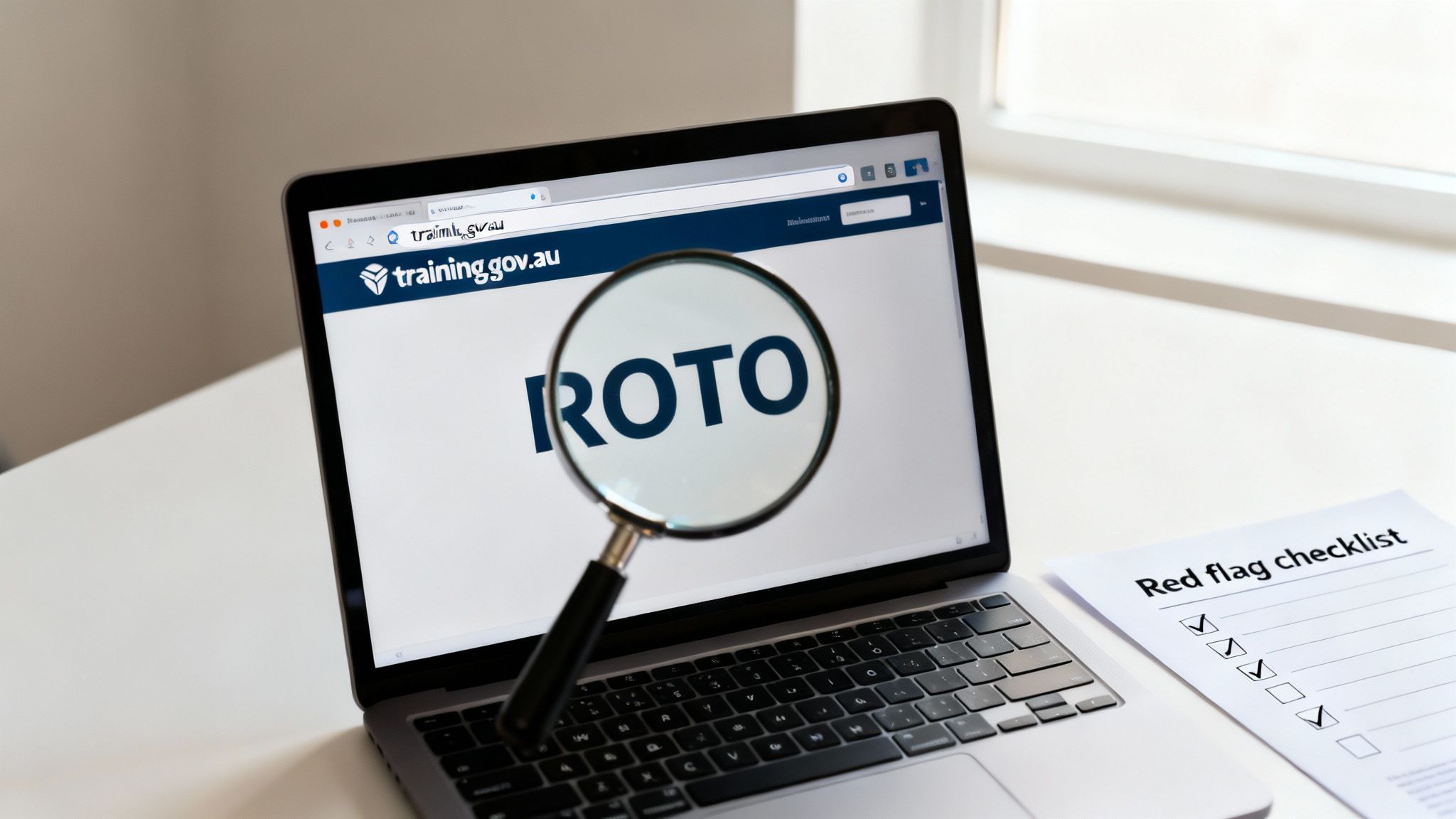
Your Step-by-Step Verification Toolkit
To confirm a provider's status, you need to go directly to the source. The Australian government maintains public databases for this exact purpose, acting as the single source of truth for nationally recognised training.
Here’s your practical, step-by-step guide:
Find the RTO Number: A Registered Training Organisation (RTO) must display its unique national code on its website. You'll usually find it in the footer or on an "About Us" page. If you can't find this number easily, that’s your first major red flag.
Use the Official Government Database: The go-to tool for checking vocational courses is the training.gov.au website. This is the definitive national register for all RTOs and accredited training in Australia. Just enter the provider’s name or RTO number into the search bar.
Analyse the Search Results: Once you find the provider, click on their profile. There are two key tabs to check:
- Registration: This confirms their current registration status. It should clearly say "Current." If it says "Cancelled" or "Expired," they are no longer approved to deliver nationally recognised training.
- Scope: This tab lists every single qualification and unit of competency the RTO is approved to deliver. If the course you want isn't on this list, the provider is not accredited to offer it as a nationally recognised qualification.
- Make Vague Claims: Look out for fuzzy phrases like "nationally approved" or "government-certified" without mentioning the AQF or giving you an RTO number. These terms are often meaningless.
- Cannot Provide an RTO Number: A legitimate RTO will have its number ready. If they dodge the question or can't give you one, walk away.
- Promise Guaranteed Job Outcomes: While a great course boosts your employability, no one can guarantee you a job. This is usually a high-pressure sales tactic.
- Lack Transparency: A credible provider will have clear, upfront information about costs, course content, assessment methods, and their policies.
- Formal Career Pathways: If you're aiming for a career with strict entry requirements—like becoming a registered nurse, an electrician, or a certified childcare worker—a nationally recognised qualification isn’t just an option; it’s a must.
- University Credit Transfer: Many AQF diplomas offer a direct pathway into a university degree, often letting you skip the first year of study. It's a brilliant, cost-effective way to get into higher education.
- Government Funding Eligibility: In most cases, only students enrolled in nationally recognised courses can access government funding or subsidies like VET Student Loans.
- Launching a Small Business or Side Hustle: An entrepreneur starting a dog-walking business doesn't need a three-year degree. They need practical skills in canine first aid, animal behaviour, and marketing—and they need them now.
- Upskilling in a Current Role: A marketing professional might take a CPD-accredited course in social media analytics to get ahead. It proves to their employer they’re committed to staying sharp. You can learn more about this in our guide on what CPD accreditation means.
- Testing a New Field: These shorter, more affordable courses are a low-risk way to dip your toes into a new industry before committing to a full-blown qualification.
- Real-World Scenario: Let's say you want to start a freelance social media management business. A CPD-accredited Certificate in Digital Marketing gives you the exact skills clients are looking for right now—from creating killer content to understanding analytics. You get the goods without the long-term commitment of a formal diploma, making it a fast, credible way to build a portfolio and land your first clients.
- A Certificate in Nutrition to grasp the core principles.
- A course in Cognitive Behavioural Therapy (CBT) to develop coaching skills.
- A certificate in Mindfulness to offer a specialised service.
- Australian Qualifications Framework (AQF): This is the big one. It's Australia's formal, government-regulated system covering everything from high school certificates to university PhDs. Its main job is to ensure qualifications are consistent and recognised everywhere in the country, creating clear pathways for students to move between different levels of education.
- Continuing Professional Development (CPD): This is all about staying current in your career. CPD accreditation confirms a course meets the standards for ongoing professional learning. It’s what helps professionals maintain their skills, keep up with industry changes, and often tick the box for renewing their professional registration or licence.
This check is non-negotiable. An RTO’s scope is like a builder's licence; it specifies exactly what they are legally permitted to build. If a qualification isn't listed, they don't have the licence for it.
Verifying Higher Education Providers
If you're looking at a higher education course, like a bachelor's degree or graduate diploma, the process is similar but uses a different regulator's database.
For these qualifications, you need to check the TEQSA National Register. This is the official database listing all higher education providers that meet Australia’s stringent quality standards. If a university or college isn’t on this register, its degrees are not recognised under Australian law.
Beyond checking the institution itself, it's also smart to see what standards the platforms that list these courses hold themselves to. For example, you can review resources like Shorepod's Trust Center for platform standards to understand how different marketplaces approach quality control.
Common Red Flags to Watch Out For
Dodgy providers often use the same old tricks. Training your eye to spot these warning signs will help you quickly filter out the questionable options.
Be wary of providers who:
By using these official tools and keeping an eye out for red flags, you can confidently verify any accredited online courses Australia offers. This simple verification process empowers you to invest in your future with complete certainty.
Nationally Recognised vs Industry Accredited Courses

Choosing between a nationally recognised qualification and an industry-accredited course is one of the biggest forks in the road you'll face. It’s not about which one is "better" but about picking the right tool for the job you want to do. The best choice depends entirely on where you’re heading.
Think of it this way: a nationally recognised qualification is like getting your official driver's licence. It’s a formal, government-regulated process proving you meet a national standard, allowing you to drive anywhere in Australia. It’s essential for certain jobs and opens up official pathways.
An industry-accredited course, on the other hand, is like taking an advanced 4WD course. It gives you specialised, practical skills for a specific purpose—like navigating tough terrain—that you can use immediately. It's incredibly useful, but it doesn't replace your official licence.
When to Choose a Nationally Recognised Course
Nationally recognised qualifications are the big guns of the Australian education system. They're part of the Australian Qualifications Framework (AQF) and are delivered by Registered Training Organisations (RTOs) like TAFE or universities.
You should make this your priority if your goals involve:
This is the structured, comprehensive route built for long-term, traditional career progression. It’s the established highway to many regulated professions.
When to Choose an Industry Accredited Course
Industry-accredited courses are all about speed, relevance, and getting your hands dirty. These courses are vetted by professional bodies (like CPD) or international standards organisations (like ICOES) to make sure they teach current, in-demand skills.
This is the perfect choice for learners who are:
The real power of industry accreditation lies in its direct link to real-world needs. It closes the gap between theory and the practical skills you need to get a job done or a business running today.
Nationally Recognised vs Industry Accredited Course Comparison
Still weighing your options? This direct comparison should help you decide which accreditation best fits your immediate and long-term goals.
Ultimately, your choice comes down to your destination. For a regulated career path, the nationally recognised highway is your best bet. But for immediate, practical skills to build a business or boost your current job, the nimble, direct route of an industry-accredited course will get you there much faster.
Finding the Right Accredited Course for Your Career Goals

Getting your head around the different types of accreditation is one thing. But the real magic happens when you connect that knowledge to your own personal ambitions. The best accredited online courses Australia offers aren't just the ones with the most impressive-sounding names; they're the ones that slot perfectly into your unique goals.
So, let's move past the theory and see how this all plays out in the real world. Whether you're building a side hustle, growing your business, or making a bold career change, matching the right accreditation to your journey is like choosing the right tool for the job. It ensures every hour and dollar you invest pushes you exactly where you want to go.
Courses for the Aspiring Side Hustler
When you're launching a side hustle, speed and practical skills are everything. You don't need a three-year degree to start offering services; you need real, marketable skills you can learn fast and start using immediately to bring in an income.
This is where industry-accredited courses, especially those with CPD or ICOES accreditation, really shine. They’re designed for one thing: rapid, practical upskilling.
These practical online certificate courses in Australia are built to get you job-ready for a specific role or business venture, and fast. They send a clear signal to the market that your skills are current, relevant, and verified by a respected industry body.
Education for the Small Business Owner
As a small business owner, you’re juggling a dozen different roles at once. Your time is your most valuable asset, so any training you take on has to deliver a direct, measurable return. You're after skills that boost efficiency, build credibility, and fuel growth—yesterday.
Industry-backed qualifications give you that targeted knowledge you can implement straight away. It's also worth understanding what makes for effective online training programs in general, as the principles of good course design can help you spot a winner.
For the small business owner, an industry-accredited certificate isn't just another line on a resume—it's a tool for immediate business improvement. It shows a commitment to professional standards that can really set you apart from the competition.
Imagine a skilled tradie who wants to get a better handle on their projects. A short course in project management fundamentals could help them streamline workflows, manage budgets, and nail client communication. The result? Better profits and an even stronger reputation.
Pathways for the Motivated Career Changer
Thinking about changing careers can feel huge, but you don't always have to go back to uni to make it happen. For many people, the smartest move is to strategically "stack" several practical, industry-accredited certificates. This lets you build a powerful and highly specialised skill set for your new profession.
It's a fantastic way to build a compelling portfolio of skills that proves your expertise and passion for a new field. Plus, it's a flexible and cost-effective way to pivot without having to start completely from scratch.
This combination creates a unique skill set that’s incredibly relevant. It shows potential clients and employers that you have a deep, practical understanding of the wellness field. It's a modern, agile way to build a new career from the ground up.
Your Next Steps to Enrolling with Confidence
Navigating Australia's world of online education can feel like a maze, but you're now armed with the knowledge to make a genuinely smart choice. If there's one thing to take away, it's this: the "best" accreditation is simply the one that clicks perfectly with your personal and professional goals.
There’s no single right answer here, only the right fit for your unique path. If you're chasing a formal career or a university pathway, the structured AQF system is your North Star. But if you’re launching a business, need practical skills fast, or want to level up in your current role, industry-recognised courses offer a direct and powerful route to getting ahead.
Match the Course to Your Ambition
The most important step you can take right now is to get brutally honest about what you want to achieve. Are you aiming for a regulated profession, or do you need practical skills you can start using tomorrow? That one distinction will guide your entire search for the right accredited online courses Australia has to offer.
Your focus should always be on the outcome. An entrepreneur doesn’t need a university diploma to start a successful pet-sitting business. But a certificate in Canine First Aid, recognised by a body like ICOES or CPD, shows you're a professional and builds instant trust with clients. It's about getting the right credential for the job.
Confidence in your choice comes from knowing why you are enrolling. When the course accreditation directly supports your goal, you are investing in a clear and achievable outcome, not just collecting another piece of paper.
This clarity is your superpower. It lets you see past the flashy marketing and zero in on credentials that deliver real, tangible value to your life and career.
Taking Action with Certainty
With this insight, you can now confidently explore providers that offer practical, industry-backed qualifications. Keep an eye out for trusted accreditations that signal a real commitment to job-ready skills and professional standards.
This is your moment to move forward, not with hesitation, but with a clear plan. You have the tools to check if a course is legitimate and the know-how to match a qualification to your ambitions. Now, you can take that final, exciting step—enrolling in a course that will actually help you get where you want to go.
Got Questions? Let's Clear Things Up
Diving into the world of accreditation can feel a bit like learning a new language. You've probably got some specific questions floating around, so let's tackle the most common ones head-on. My goal here is to give you clear, straightforward answers so you can feel confident about your next step.
Are Accredited Online Courses Actually Recognised by Employers in Australia?
Yes, absolutely—but it’s all about what kind of recognition we’re talking about. The type of accreditation really matters here.
If you’re looking at a nationally recognised AQF qualification, like a Diploma from an RTO, that’s the gold standard for formal recognition. Employers across Australia accept these for jobs that have specific regulatory requirements. Think of industries like healthcare or construction, where you need that official piece of paper to even get in the door.
On the other hand, you have industry-accredited courses, like those with CPD or ICOES approval. These are incredibly valuable to employers because they signal that you have current, practical, hands-on skills. They show you’re committed to staying sharp in your field, which is a massive plus in fast-moving industries, small businesses, or specialised roles where what you can do is what truly counts.
Can I Get University Credit for an Online Accredited Course?
This is a great question. Generally, you can only get university credit for courses that are officially part of the Australian Qualifications Framework (AQF). For instance, successfully completing a Diploma from an RTO can often create a direct pathway into a university Bachelor’s degree, sometimes even letting you skip the entire first year of study.
Industry-accredited short courses are a different beast altogether. They aren't built for university credit. Their real power is in giving you fast, practical skills to get a job, start a business, or add a new service to your existing one.
Think of them as career accelerators, not academic building blocks. They're perfect when you need to upskill quickly and get moving.
What Is the Difference Between CPD and AQF Accreditation?
It's easy to get these two mixed up, but they serve completely different purposes. Understanding the distinction is key.
So, in a nutshell, the AQF is about getting a formal qualification, while CPD is about maintaining and sharpening your professional skills once you're in the game. Both are valuable, but they're designed for very different journeys.
Ready to gain practical, job-ready skills with a trusted provider? At Prac Skills AU, our courses are industry-accredited by ICOES and CPD, focusing on the real-world expertise you need to start your side hustle or grow your business. Explore our range of practical, self-paced courses today at https://www.pracskills.com.au.