February 3, 2026
.webp)

Your Guide to a Certificate for Animal Care in Australia
Explore how a certificate for animal care can launch your career. This guide covers courses, career paths, and online study options in Australia.
Career Development
minutes
A certificate for animal care is your formal entry ticket into Australia's professional animal services industry. It’s much more than just a piece of paper; it’s a verified toolkit that proves you have the essential, practical skills to look after animals safely, ethically, and competently.
What a Certificate for Animal Care Really Means for Your Career

Think of an animal care certificate like a trade qualification. Just as you’d hire a licensed electrician to handle your home's wiring, pet owners are now actively seeking out professionals with certified training for their beloved companions.
This qualification is a clear signal of trust, quality, and a serious commitment to high standards of animal welfare. In a competitive market, it immediately sets you apart. It shows employers and clients that you've invested in your education and are serious about building a real career.
Why Certification Is Becoming Non-Negotiable
The demand for skilled professionals is growing, and fast. In Australia, the animal care and management sector is booming, with 58,400 employees already working in roles that require these certified skills.
It doesn’t stop there. Projections show that jobs for animal attendants and trainers are set to surge by 14.9% by November 2026. That creates a need for thousands of new, qualified workers. This growth is directly linked to Australia's massive pet population and an ever-increasing demand for specialised care, as highlighted in the Skills Insight Initial Workforce Plan.
This industry shift makes a certificate for animal care more than just an advantage—it's quickly becoming an essential requirement.
Pursuing a formal qualification is a direct investment in your credibility. It demonstrates a professional commitment to animal welfare that builds immediate trust with both employers and pet owners, giving you a significant edge in the industry.
To put it simply, getting certified is one of the smartest moves you can make if you're serious about working with animals. Here are the top five reasons why.
Top 5 Reasons to Get Certified in Animal Care in Australia
This formal training ensures you're not just relying on passion, but are equipped with the professional knowledge to make a real difference.
Building Your Professional Toolkit
A good course provides a well-rounded education covering the core pillars of professional animal services. This isn't just about textbook theory; it's about gaining practical, job-ready skills that you can apply from your very first day on the job.
A certificate for animal care also provides comprehensive knowledge in specialised areas, including the vital principles and practical tips for things like animal enrichment for pet birds.
Key areas of study almost always include:
- Animal Health and First Aid: Learning to recognise signs of illness or injury and provide immediate, effective care.
- Behaviour and Handling: Understanding animal psychology to ensure safe and low-stress interactions for everyone involved.
- Nutrition and Diet: Knowing the specific dietary needs of different species to promote their optimal health and wellbeing.
- Welfare and Ethics: Upholding the industry's high standards for the humane and ethical treatment of all animals under your care.
Ultimately, this qualification is the foundation upon which you can build a successful and rewarding career, turning your passion for animals into a respected profession.
Navigating Your Animal Care Qualification Options

When you first start searching for a certificate for animal care, you'll quickly discover there are two main pathways available in Australia. Figuring out the difference between them is the first, and most important, step in choosing a qualification that actually gets you where you want to go.
Essentially, your options boil down to nationally accredited VET qualifications and industry-recognised CPD courses. Each is designed for a completely different purpose and leads to different career outcomes.
Think of it this way. A nationally recognised VET course is like becoming a licensed builder. It’s a formal, in-depth qualification that falls under the Australian Qualifications Framework (AQF), making it perfect for structured roles like becoming a veterinary nurse or an animal technician in a research lab. These courses are generally longer and more comprehensive.
On the other hand, an industry-recognised CPD (Continuing Professional Development) certificate is more like a specialised workshop to master a specific craft, like becoming an expert tiler. It’s faster, highly focused, and designed to give you job-ready skills to launch a business like dog walking or pet sitting right away.
Accredited VET Qualifications Explained
Vocational Education and Training (VET) courses are the formal, government-endorsed route, typically offered by TAFEs or Registered Training Organisations (RTOs). These are the qualifications you’ll often see listed for clinical or institutional roles:
- Certificate II in Animal Care: This is your entry point, ideal for building foundational skills for jobs in kennels, shelters, or pet shops.
- Certificate III in Animal Care Services: A more comprehensive qualification that builds on the basics, setting you up for roles with more responsibility.
- Certificate IV in Veterinary Nursing: The highly specialised qualification you need to work as a qualified vet nurse inside a clinic.
These qualifications are recognised by all employers nationwide and are non-negotiable for certain regulated professions.
Industry-Recognised CPD Courses Explained
CPD-accredited courses are recognised by industry bodies and employers because they focus on practical, current, and relevant skills. They’re designed from the ground up to be efficient and incredibly targeted.
A CPD certificate is your express lane to acquiring practical, in-demand skills. It cuts through the extensive theory of a VET course to give you exactly what you need to start a business or enter a role like pet sitting with confidence and credibility.
Instead of broad academic modules, CPD courses zero in on the specific units of competency you’ll be using every day. They’re brilliant at translating complex industry jargon into the real-world skills you'll actually use on the job.
For instance, a unit called 'Provide basic first aid for animals' means you’ll learn precisely how to handle common emergencies like bleeding, choking, or heatstroke. A unit on 'Work effectively in the companion animal industry' teaches you the business side of things, like how to communicate with clients and uphold professional ethics.
Ultimately, the best choice really comes down to your career destination. If a formal clinical role is your goal, a VET qualification is the path for you. But if you want to quickly and affordably launch your own pet service business, a practical, industry-backed CPD course is often the smarter, faster move. For those still exploring, you can learn more about flexible online animal care courses to see which style best fits your life and goals.
So, What Can You Actually Do With an Animal Care Certificate?
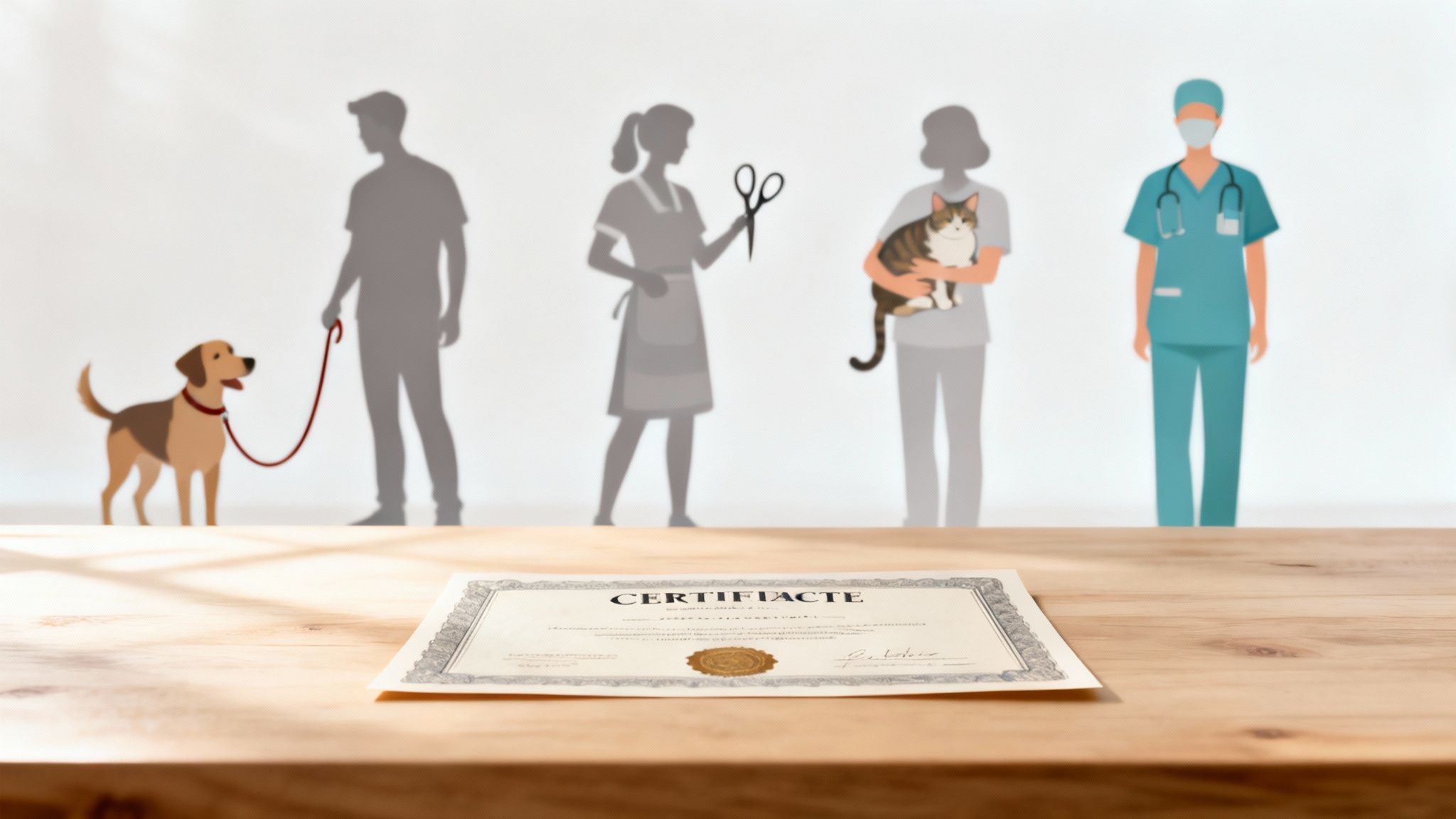
Getting a certificate for animal care isn't just about adding another line to your resume. Think of it as your all-access pass to Australia’s booming pet industry. It’s the key that unlocks a world of rewarding, hands-on career opportunities, whether you're dreaming of a full-time role or a profitable side hustle.
The skills you learn are real, practical, and in-demand right now. This qualification is a direct pathway to turning your passion for animals into a real-life profession.
From Side Hustle to Full-Time Career
Let's be clear: the demand for skilled animal care professionals in Australia is massive and growing. With over 30 million pets across the country, including 6.33 million dogs, the need for top-notch grooming, training, and pet-sitting services has never been higher.
Annually, Aussies spend a staggering AU$22 billion on their pets, and dog owners are a huge part of that. This creates a thriving market where certified professionals can build a reliable income. It makes roles like pet sitting and dog walking more than just pocket money—they're genuinely viable careers.
Armed with a certificate, you can confidently market your services, backed by formal training in everything from animal first aid and behaviour to safety protocols.
Popular Career Paths You Can Take
Your certificate is a launchpad for all sorts of different roles. While each job has its unique demands, the foundational knowledge from your course is the thread connecting them all, setting you up for success.
Here are a few popular options:
- Animal Shelter Attendant: This is where you work on the front lines, providing daily care, enrichment, and comfort to animals in need. Your qualification is proof that you can handle animals safely and compassionately, even in a high-stress environment.
- Veterinary Assistant: You'll become a vital support for vets in a clinical setting, helping with animal handling, basic procedures, and client communication. If this sounds interesting, check out our guide on how to become a vet assistant.
- Professional Pet Sitter or Dog Walker: Start your own business with the credibility clients are desperate for. A certificate shows you’re serious about animal welfare and have the skills to handle whatever comes your way.
- Dog Groomer: A fantastic hands-on career for creative types. You'll master everything from bathing and clipping to spotting potential skin conditions. The demand is huge!
A certificate for animal care is your launchpad. It’s the proof that transforms you from an 'animal lover' into a trusted, professional service provider that clients will happily pay for and recommend.
And you don't have to stop there. This qualification can give you the confidence and know-how to dream bigger. It’s the perfect foundation for launching your own venture, like a successful mobile pet grooming business, giving you complete flexibility and control over your career.
How to Choose the Right Animal Care Course for Your Goals

Picking the right certificate for animal care is a huge decision, and it’s one that will steer the course of your career. With so many options out there, it’s completely normal to feel a bit swamped. The trick is to find a course that clicks with your goals, your lifestyle, and your budget.
Think of it like choosing a vehicle. You wouldn't buy a massive ute just to zip around the city, and you wouldn't try to haul tools for a trade in a tiny hatchback. Both will get you from A to B, but they’re built for totally different jobs. The same logic applies to your education.
To cut through the noise, you need a clear way to weigh up your options. Let's break down the must-have factors to consider so you can find the perfect fit for your journey into the animal care industry.
Accreditation: VET vs. Industry Recognised CPD
The first big fork in the road is understanding what kind of accreditation a course has. As we’ve touched on, this is probably the single most important difference between the qualifications you’ll see advertised.
Nationally Recognised VET Courses: These are the formal qualifications that sit within the Australian Qualifications Framework (AQF), like a Certificate III you might do at TAFE. They are absolutely essential for certain jobs, like becoming a veterinary nurse, where that specific certificate is a non-negotiable requirement to even get your foot in the door. These courses are generally longer and more expensive.
Industry-Recognised CPD Courses: Qualifications like the ones we offer at Prac Skills AU are accredited by professional bodies, such as the CPD Certification Service. They’re designed to be fast, hands-on, and razor-focused on giving you job-ready skills for starting a business or getting into roles like pet sitting, dog walking, or kennel work. They offer a super-efficient and affordable way to gain professional credibility.
So, what’s your ambition? If you're aiming for a clinical role, the formal structure of a VET course is what you need. But if you want to launch your own pet business fast, the targeted, practical skills from a CPD course are your ticket.
Learning Flexibility and Practical Skills
Life is busy, and your study schedule has to bend around your commitments, not the other way around. This is where the delivery method of a course becomes a game-changer. Rigid, on-campus timetables just don’t work for everyone anymore.
Self-paced online learning has blown up as a popular and seriously effective alternative, especially for adults juggling work, family, and everything in between. The best providers give you the freedom to learn whenever it suits you—late at night, on weekends, you name it—without the pressure of looming deadlines.
The best online courses don't just throw theory at you. They're cleverly designed to build real-world skills through video demos, practical case studies, and hands-on assignments you can complete right from home.
Look for a program that assesses practical skills in a way that makes sense for you. This is how you know you're not just memorising facts from a textbook but are actually getting prepared to handle animals safely and with confidence. It's something the National Animal Care & Control Association (NACA) always highlights—good, accessible training is key to lifting standards across the entire industry.
Comparing Animal Care Qualifications: VET vs. Online CPD
To make your decision even clearer, we’ve put together a simple table that lays out the key differences between the two main types of qualifications.
This table should help you quickly see which path aligns best with where you want to go.
By weighing these factors against your own personal and professional goals, you can confidently choose a certificate for animal care that puts you squarely on the path to a career you’ll love.
Your Next Steps to Getting Certified and Starting Your Career
Feeling that spark of inspiration to turn your love for animals into a real career? Hold onto that feeling. That excitement is the best fuel you can have, and now it's time to channel it into a clear, straightforward plan that gets you from dreaming to doing.
Getting started always feels like the biggest hurdle, but it doesn't have to be a confusing leap. Think of it as a simple, three-step journey to your first day on the job.
Step 1: Define Your Career Goal
First things first: you need a destination. A clear goal is your compass, guiding every decision you make from here on out. Are you picturing yourself launching a five-star pet sitting business? Or maybe you want to be the most trusted dog walker in your neighbourhood.
Perhaps your passion lies in helping animals find their forever homes at a shelter, or you see yourself working at a local kennel. Your end goal is what really matters because it dictates which certificate for animal care will be the best fit. A super-focused, practical course is perfect for starting your own business, whereas a broader qualification might be better suited for a role within an established organisation.
Step 2: Find and Enrol in the Right Course
Once you know where you're headed, it's time to find the course that will get you there. Think back to the key factors we talked about earlier:
- Accreditation: Will an industry-recognised CPD certificate give you the credibility you need to launch your business, or does the job you want require a nationally recognised VET qualification?
- Flexibility: Life is busy. You need a program that bends around your schedule, not the other way around. Self-paced online learning is a game-changer for adults juggling work, family, and study.
- Practical Focus: Theory is great, but you need skills that work in the real world. Make sure the course is packed with job-ready skills you can start using the day you graduate.
The right course isn’t just about the piece of paper you get at the end. It's about finding a learning experience that genuinely builds your confidence and prepares you for the realities of the job.
Take your time and explore all the options. For anyone looking to start a business or even a side hustle, you’ll probably find the perfect match among the many flexible animal care courses available online.
Step 3: Market Your New Skills
You've done the work and earned your certificate—now it's time to show it off! Don't be shy about your new qualification. It’s a powerful tool for building trust with clients and standing out from the crowd.
- Update Your Profile: Add your shiny new certificate to your LinkedIn profile, your business website, and all your social media pages.
- Create a Portfolio: Start collecting testimonials from your first few happy clients. Nothing builds confidence in new customers like seeing rave reviews from others.
- Highlight Your Skills: When you're chatting with potential clients, be sure to mention that you're professionally trained in crucial areas like animal first aid and safe handling. This instantly separates you from hobbyists and positions you as a true professional.
Your certificate is your proof of expertise. Use it to build a rock-solid reputation and kickstart a career that’s as rewarding as it is fun.
Common Questions About Animal Care Certificates
Diving into the world of animal qualifications can feel a bit overwhelming, and it’s natural to have questions. To help you feel confident about your next step, we’ve put together some straightforward answers to the queries we hear most often.
Do I Need a Certificate to Start a Dog Walking Business in Australia?
While you might not find a strict law that demands it, getting certified has quickly become the new industry benchmark. It’s about more than just a piece of paper; it’s about professionalism.
Having a certificate instantly builds trust with potential clients, showing them you’re serious about their pet’s safety and wellbeing. It proves you have critical skills in animal first aid and behaviour, which is a massive selling point. Crucially, many business insurance providers now see a formal qualification as a non-negotiable for providing coverage.
Can I Get a Respected Animal Care Certificate Entirely Online?
Absolutely! Heaps of reputable providers now offer industry-recognised certificates that are completed 100% online. These aren’t just glorified reading exercises; modern courses are designed for real-world application. They use a mix of video tutorials, practical assignments you can do at home, and online assessments to build genuine, job-ready skills.
For nationally recognised VET qualifications, you’ll often do the theory component online, but this will be paired with a mandatory in-person work placement to get that hands-on experience.
The real secret is to pick a course that’s focused on practical outcomes. A great online certificate gives you the same job-ready skills and industry recognition as an in-person workshop, just with the freedom to fit it into your life.
What Is the Main Difference Between a TAFE Course and a CPD Certificate?
Think of it this way: a TAFE qualification, like a Certificate III in Animal Studies, is a big, comprehensive course that’s part of the official Australian Qualifications Framework (AQF). These are often longer, more in-depth, and are essential for regulated roles like becoming a vet nurse.
A CPD-accredited certificate, on the other hand, is all about professional development recognised by the industry itself. These courses are typically faster, more affordable, and laser-focused on a specific, practical skill set. This makes them perfect for someone wanting to start a business or upskill in a particular area without the long-term commitment of a full VET course.
How Much Does a Certificate for Animal Care Typically Cost in Australia?
The costs really do vary depending on what you’re studying. An industry-recognised online CPD course is a fantastic entry point, usually costing anywhere from a few hundred to around a thousand dollars.
If you’re looking at a more extensive, nationally recognised VET qualification from an institution like TAFE, you’ll generally be looking at several thousand dollars. The final price tag there will depend on the level of the course and whether you’re eligible for any government funding.
Ready to turn your passion into a profession with a practical, industry-recognised certificate? At Prac Skills AU, we offer flexible, self-paced courses designed to give you the job-ready skills you need to succeed in Australia's animal care industry. Explore our courses today at https://www.pracskills.com.au.