February 3, 2026
.webp)

Career Change at 30: A Practical Guide to Pivot Your Career
Thinking about a career change at 30? Get practical, step-by-step guidance to pivot confidently in Australia, from self-discovery to action.
Career Development
minutes
Thinking about a career change at 30? It’s a thought that crosses the minds of so many Aussies. Far from being a crisis, this decade is often the perfect time to reassess, realign, and chase a career that truly fits. It's that sweet spot where you're driven by a search for more purpose, better work-life balance, and fresh challenges.
Why Hitting 30 is the Perfect Time to Pivot

Hitting your thirties often feels like a significant milestone. You’ve likely spent the better part of a decade in the workforce, gaining real experience and, just as importantly, figuring out what you don’t want. This isn’t about hitting a panic button; it’s about gaining clarity.
That feeling of being stuck or unfulfilled is more common than you think. Data from the Australian Bureau of Statistics (ABS) shows a robust 11.2% job change rate for workers aged 25-44. And the top reason? A massive 33.1% of movers said it was for 'a better job or just wanting a change'. It's clear that people in their thirties are actively looking for something more. You can dive deeper into these job mobility trends for Australian professionals.
You’re Not Starting from Scratch
Let's get one thing straight: changing careers at 30 isn't like starting out at 20. You now have a solid foundation of real-world knowledge. You’ve navigated office politics, managed projects from start to finish, and developed a proper work ethic. These aren't just bullet points for a resume; they're valuable, transferable skills that give you a huge leg up.
This experience also brings a level of self-awareness that’s hard to come by in your early twenties. You know your strengths, your weaknesses, and what truly motivates you beyond a paycheque. That insight is your most powerful tool for choosing a new path that offers genuine, long-term satisfaction.
A career change at 30 isn't starting over. It’s a calculated pivot, using the skills and wisdom you've already earned to build something more aligned with who you are today.
Common Triggers for Making a Move
Several things often push people to rethink their careers around this age. Seeing these might validate what you're feeling and show you you’re not alone.
- Chasing a Sense of Purpose: The desire for work that feels meaningful becomes a lot stronger.
- Reclaiming Work-Life Balance: Your priorities have probably shifted, and a 60-hour work week just doesn't cut it anymore.
- Industry Disruption: Your current field might be changing thanks to tech or economic shifts, prompting a proactive move.
- Personal Growth: You've simply outgrown your first career choice and you're ready for a new challenge.
Understanding what's driving you is the first step. The rest of this guide is your roadmap to planning and making your career change a success. To give you a bird's-eye view, here's a look at the key phases we’ll walk through together.
Your 4-Phase Career Change Roadmap
This table breaks down the entire process into four manageable stages. Think of it as your high-level game plan.
Each phase builds on the last, guiding you from that initial "what if?" feeling to confidently stepping into your new career. Now, let’s get into the details.
Uncovering What You Truly Want Next

Before you even think about scrolling through job ads or signing up for a new course, the most critical move in a successful career change at 30 is to look inward. Seriously. After a decade in the workforce, you’re sitting on a goldmine of data—your own experiences—that can tell you exactly what you need from your next chapter. This isn't about daydreaming; it's a practical, honest audit of your professional life so far.
The aim here is to cut through the noise of what you think you should want and get to the core of what genuinely gets you fired up. It’s far too easy to get distracted by flashy job titles or chasing a bigger paycheque, but real, lasting career satisfaction comes from matching your day-to-day work with what you truly value.
The Energy Audit Technique
A brilliantly simple yet powerful starting point is what I call an 'Energy Audit' of your current or most recent job. Forget your official job description for a minute and think about your actual, real-life week. Grab a notebook and split a page into two columns: "Energisers" and "Drainers."
For one full week, jot down every single task, meeting, or interaction and stick it in the appropriate column.
- Energisers: What activities left you feeling capable, engaged, and maybe even a little buzzed? Perhaps it was mapping out the team's project timeline, coaching a junior colleague through a tough spot, or cracking a complex client problem.
- Drainers: What made you watch the clock, feel frustrated, or just plain exhausted? This could be anything from mind-numbing data entry and navigating office politics to giving a presentation.
At the end of the week, step back and look for the patterns. Your "Energisers" column is your roadmap. It points directly to the kind of work and environment where you’re already wired to succeed.
Your feelings are data. The tasks that energise you are clues to a more fulfilling career. The ones that drain you are the non-negotiables to leave behind.
Defining Your Career Non-Negotiables
With your energy audit in hand, you can start building a list of your non-negotiables—the absolute must-haves and deal-breakers that will steer your search. Think about these key areas:
- Work Environment: Do you thrive in a buzzing, collaborative team, or is your best work done solo? Are you energised by an open-plan office, or do you need the focus and flexibility that comes with remote work?
- Company Culture: Are you after the fast-paced, high-risk world of a startup, or the stability and structure of a larger corporation? Consider what values matter most, whether it's creativity, social impact, or a genuine commitment to work-life balance.
- Daily Tasks: Based on your audit, what kinds of problems do you actually enjoy solving? Do you get a kick out of big-picture strategic thinking, hands-on creative work, or are you happiest when you’re interacting with people all day?
Being brutally honest with yourself here is what will stop you from just hopping from one bad-fit role to another. It ensures your next move is a real step up.
Mapping Your Hidden Superpowers
One of the biggest blunders I see career changers make is completely underestimating the skills they already have. You've spent a decade honing valuable transferable skills—abilities that are highly sought after in totally different industries. You are not starting from scratch.
Let’s look at a real-world example. Imagine an admin manager, "Sarah," who's dreaming of a career in animal care. On the surface, those two worlds couldn't be further apart. But when we map her skills, a different picture emerges.
Sarah's Admin Manager Skills (The "Old" Career):
- Scheduling & Logistics: Juggling complex calendars for an entire executive team, coordinating meetings, and handling intricate travel arrangements.
- Client Communication: Being the professional and empathetic first point of contact, handling all kinds of inquiries, and resolving issues on the spot.
- Budget Management: Tracking departmental expenses, processing invoices, and keeping everything within its financial limits.
- Problem-Solving: Deftly handling last-minute schedule changes, finding quick solutions to office crises, and generally keeping the ship afloat.
Now, let's reframe those skills for her dream business: running a pet-sitting or dog-walking service.
How They Translate to Animal Care (The "New" Career):
- Scheduling & Logistics is now managing complex booking schedules for dozens of clients, planning the most efficient dog-walking routes, and coordinating vet appointments.
- Client Communication is now building deep trust with pet owners, sending them reassuring updates, and handling sensitive situations with compassion.
- Budget Management becomes the essential skill of setting service prices, tracking business expenses, and ensuring her venture is profitable.
- Problem-Solving is now absolutely critical for dealing with an anxious dog, managing an unexpected medical issue, or handling a last-minute cancellation with grace.
See? Sarah isn't starting over at all. She’s simply applying her decade of hard-earned expertise to a field she’s passionate about. Take the time to do this exercise for yourself. List your current responsibilities, then reframe them as powerful, transferable skills. You'll likely discover you’re far more qualified for something new than you ever imagined.
Researching Career Paths That Actually Excite You
Alright, you've done the internal work. You've got a much clearer picture of your strengths, what you value, and the kind of work that actually lights you up. Now it's time to look outwards. This is the moment your career change at 30 starts to feel less like a dream and more like a plan.
The goal here isn't just to find any job. It's about finding industries and roles that are a genuine match for the person you've become. This is all about smart, targeted exploration—connecting what you’ve learned about yourself with what’s happening in the real world to find a path that’s both fulfilling and financially sustainable.
Pinpointing High-Growth Sectors in Australia
Your next great career might be in a field you've barely even thought about. Right now, certain industries in Australia are booming, which creates incredible opportunities for motivated career changers. These sectors are often desperate for good people and are far more open to hiring based on transferable skills.
So, where is the growth happening?
- Digital Skills: Think digital marketing, content creation, and social media management. Every business, from the local cafe to a national brand, needs people who can help them connect with customers online. This is a space where practical, proven skills often trump a formal degree.
- Wellness and Therapy: With a growing focus on mental and physical wellbeing, the demand for coaches, therapists, and practitioners is soaring. This includes everything from mindfulness and nutrition to holistic health.
- Skilled Trades and Hands-On Services: Don't underestimate the demand for practical expertise. We’re seeing huge growth in businesses centred around horticulture, indoor plant styling, or specialised animal care like dog walking and pet sitting.
- Community and Personal Services: This is a massive field driven by human connection. It covers everything from aged care support to becoming a trusted local handyman or service provider.
This isn't just a gut feeling. We're seeing a huge shift in the Australian workforce. ABS data shows that 26% of mid-career Aussies are jumping into completely new industries. The biggest winners? Community and personal services, which are seeing a massive influx of talent. You can read more about these major shifts in the Australian workforce to see just how much things have changed.
The Power of the Informational Interview
Reading a job description will only get you so far. To get a real feel for what a career is like day-in and day-out, you need to talk to the people who are actually living it. This is where the informational interview becomes your secret weapon.
An informational interview isn't a sneaky job interview. It's a relaxed chat designed to get you insider knowledge, check your assumptions, and build your network before you even think about applying for a role.
Your mission is simple: find out what the job is really like—the good, the bad, and the stuff no one puts in the ad. You’ll be surprised how many people are happy to share their story if you just ask with genuine curiosity. LinkedIn is a great place to start; just search for job titles in companies or industries that have caught your eye.
What to Ask to Get Real Answers
When you reach out, keep it brief and be respectful of their time. A simple message asking for 15-20 minutes to hear about their career journey usually works well. Once you've got them on a call, ditch the generic questions and go deeper.
Try asking things that get you honest insights:
- "What does a typical day or week actually look like in your role?"
- "What’s the most challenging part of your job that people outside the industry wouldn't expect?"
- "What skills do you think are the most critical for success in this field right now?"
- "If you were starting over in this career today, what would you do differently?"
These conversations are pure gold. They’ll either confirm that you’re on the right track or save you from a costly mistake by showing you that the reality of a role isn’t what you imagined. This is how you move from a vague idea to a confident decision, armed with the knowledge to pursue high-income skills that align with your goals.
Upskilling Without a Four-Year Degree
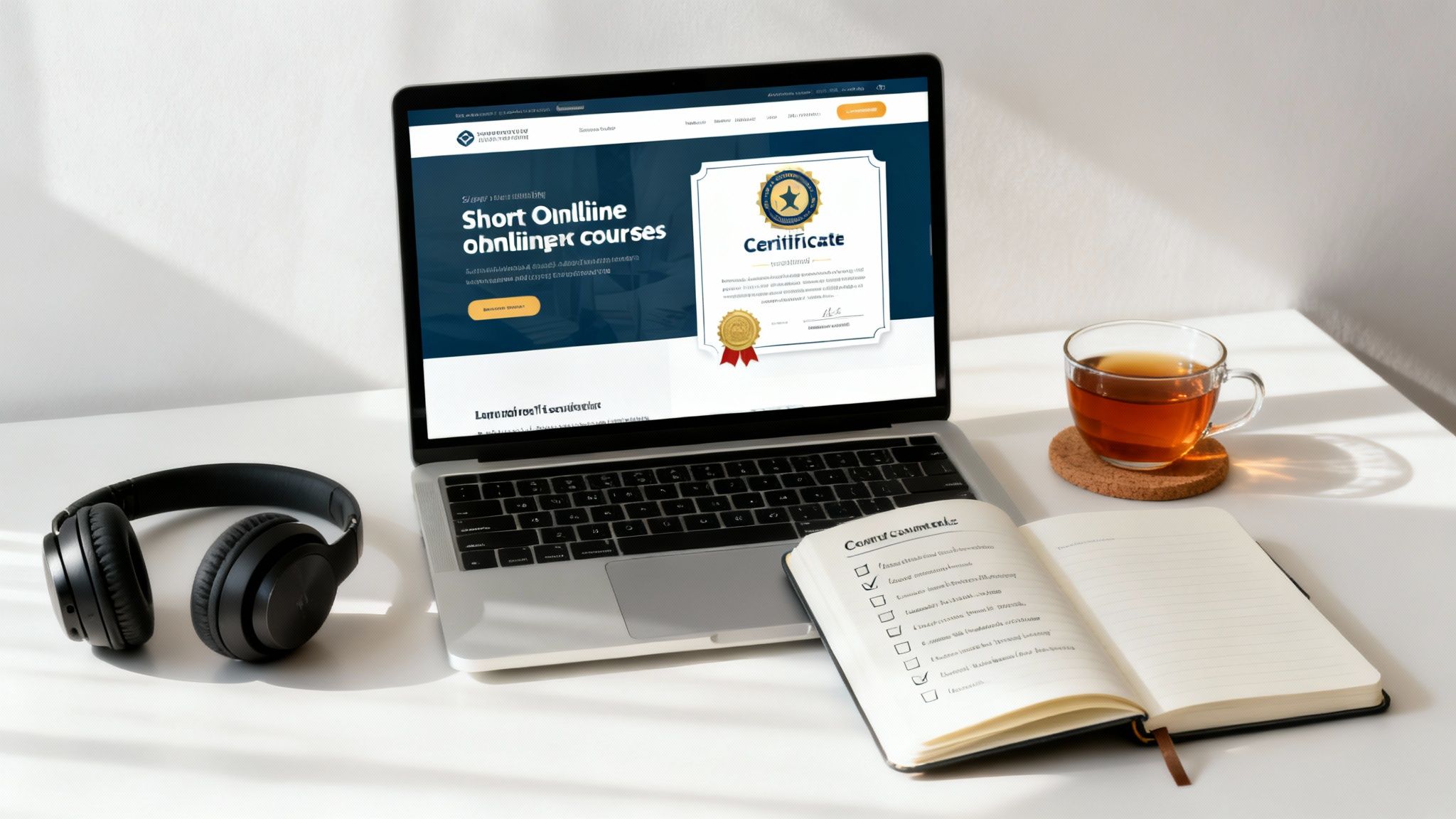
So you've figured out a new path that actually feels right. Awesome. But then comes the question that stops most career changes dead in their tracks: "How on earth do I get the right skills without going back to uni for years?"
Here's the good news. The old model of racking up HECS debt for another four-year degree is no longer the only way—or even the best way—to pivot your career.
The modern approach is all about being fast, practical, and relevant. It’s about getting job-ready skills that you can directly apply in your new field, letting you make the switch much sooner and with a lot more confidence. Forget broad, theoretical knowledge; you need to focus on the specific competencies that get you hired now.
This shift is huge. A massive barrier for people wanting to change careers is the feeling that they're going it alone, with 32% of Australians citing a lack of support as a major issue. Fast, practical training solves this by giving you a clear, manageable roadmap.
With industries like community and personal services seeing a 14% mobility rate, getting an accredited certificate in a field like Animal Care or Wellness Therapy gives you the exact skills to step confidently into these growing sectors.
Choose Fast and Focused Training
Think about what you'll actually do day-to-day. If you're keen to get into the creative economy, a practical course on AI Art Monetisation provides tangible skills you can start using immediately. If your dream is starting a local pet care business, a Certificate in Dog Walking delivers the specific knowledge—from canine behaviour to business basics—that will genuinely help you succeed.
The key is to find training that is:
- Industry-Recognised: Look for courses with accreditations that employers and clients actually respect.
- Self-Paced: Find an option that lets you learn around your current job and life, not one that forces you into a rigid uni timetable.
- Australian-Focused: The content needs to be tailored to our local market, regulations, and what Aussie clients expect.
Many successful career changers learn to master any skill on your own through self-study, which is an incredibly powerful way to get ahead. This approach puts you in the driver's seat, letting you focus intensely on what truly matters for your new career.
Forget the 'all or nothing' mindset. The smartest way to upskill for a career change at 30 is with targeted, practical training that gets you from A to B efficiently, without putting your life on hold.
Why Accreditation Builds Your Credibility
When you’re breaking into a new field, credibility is everything. It’s what gives you the confidence to put yourself out there and what gives clients or employers the confidence to hire you. This is where official accreditations are worth their weight in gold.
An accreditation is a clear signal that you’ve met a certain professional standard.
Look for qualifications with recognition from bodies like:
- ICOES (International Council for Online Educational Standards): This provides an international benchmark for quality, showing your training is globally recognised.
- CPD (Continuing Professional Development) Points: Many industries require professionals to earn CPD points to stay current. Having these from the get-go shows you're serious about your new field.
These credentials aren't just lines on a resume; they are powerful trust signals. They help you get past the "but you don't have experience" hurdle by proving you've invested in learning the right way. They validate your new direction and give you a solid foundation to build from.
By choosing smart, targeted training, you’re not just learning new skills—you're building a bridge to your next chapter. It’s one of the most effective ways to plan a successful pivot, as you can see in our guide on the benefits of online short courses in Australia. You’ll gain momentum, build confidence, and get the exact tools you need to make your career change a reality, much faster than you ever thought possible.
Laying Out Your 12-Month Transition Plan

An idea without a plan is just a dream. This is where your career change at 30 gets real. We’re going to take that big, ambitious goal and break it down into a manageable 6 to 12-month timeline. Think of it less as a giant leap and more as a series of achievable, well-placed steps.
Having a structured plan is your best defence against feeling lost or overwhelmed. It gives you a clear focus, lets you see your progress, and builds momentum in all the right places. We’ll build this strategy around four crucial pillars: Learning, Finances, Experience, and Networking.
The Four Pillars of Your Career Pivot
Each pillar is like a project in its own right, but they all need to work together. A solid financial base gives you the freedom to focus on learning. That learning helps you gain real experience. And that experience makes your networking efforts a hundred times more effective.
Let's quickly break down what each one involves:
- Learning and Upskilling: This is all about mapping out your study timeline. You'll figure out how long it will take to complete your chosen course and earn the qualifications needed to walk into your new field with credibility and confidence.
- Financial Planning: Time to get serious about money. This means creating a specific transition budget, building up a safety net, and knowing exactly how long your financial runway is.
- Gaining Experience: Theory is one thing, but practical skills are what get you in the door. This pillar is focused on getting your hands dirty through volunteering, freelance gigs, or even personal projects that showcase your new skills.
- Networking and Connection: It’s not just about what you know; it’s who you know. This is about strategically building relationships in your target industry before you actually need them. You'll learn from others and get on the radar of the right people.
By focusing on these four areas, you create a balanced approach that covers all your bases and sets you up for a smooth transition.
Building Your Financial Runway
Before you even think about handing in your notice, you need to get brutally honest about your finances. A successful career pivot requires a financial buffer. It’s not just about paying the bills; it’s about reducing stress and giving yourself the mental space to make good decisions.
Your first job is to create a transition budget. This isn't your regular household budget. It needs to account for your current income, any spending you can cut back on, and the costs of your change, like course fees.
The main goal here is to save an emergency fund of at least three to six months of essential living expenses. This fund is your safety net. It's what allows you to focus on your studies and job search without money worries constantly hanging over your head.
A well-planned financial buffer doesn't just pay the bills; it buys you peace of mind. It’s the freedom to make choices based on opportunity, not desperation.
Gaining Practical Experience While You Still Work
One of the smartest ways to de-risk your career change is to get a real taste of your new field before quitting your current job. Gaining hands-on experience not only confirms you’re on the right track but also starts building a portfolio that makes you a much stronger candidate.
Here are a few low-commitment ways to build your skills:
- Volunteer Your Time: Offer your new skills to a local charity or community group. A non-profit would likely be thrilled to have someone help out with their social media or website, for example.
- Take on Freelance Projects: Jump onto platforms like Upwork or simply ask around in your network to find small, paid projects. This not only builds experience but can also start bringing in a little income from your new field.
- Start a Personal Project: Launch a blog, build a small online shop, or create a portfolio website. These things showcase your passion and your ability to be a self-starter. If you’re pivoting to horticulture, for instance, you could document your journey creating a specialised indoor garden.
These actions are what turn your skills from something you’ve learned into something you’ve proven. As you get closer to your job search, you’ll need to frame all this new experience on your resume. Looking through some well-structured career change resume examples can give you some fantastic ideas on how to present your pivot in the most powerful way.
Mapping Out a Sample Timeline
A timeline is what brings all these moving parts together into an actionable plan. Everyone's journey is different, of course, but you can use this sample structure as a starting point and adapt it to your own goals. If you're wondering how to fit study into an already busy schedule, it's worth exploring how different online learning platforms in Australia can support your journey with flexible options.
Here’s a look at what a 12-month transition could look like, broken down into manageable chunks.
Sample 12-Month Career Transition Timeline
Remember, this timeline isn't set in stone; it’s a framework to guide you. The real key is to break that big, intimidating goal of a "career change" into small, weekly actions that consistently push you forward.
Grappling with the Fear and Making the Leap
Alright, let's talk about the part of a career change at 30 that you can't map out on a spreadsheet: the mental game. It's totally normal to feel a wild mix of excitement and straight-up terror. One minute you're buzzing about the future, the next you're wondering what on earth you're thinking.
You’re about to walk away from a world where you knew your stuff, where you were the go-to person, and step into a new arena as the rookie. This is where your mindset isn't just important—it's everything. The biggest battles are usually the ones fought in your own head, but facing them head-on is the only way to keep moving forward.
Taming That Inner Critic (aka Imposter Syndrome)
Ever heard that little voice in your head whispering, "You're a fraud! You have no idea what you're doing!"? That's imposter syndrome, and it gets especially loud when you go from a decade of experience back to being the new kid on the block.
Here’s the secret: you don't wait to feel confident before you act. You have to act your way into feeling confident.
Forget the massive goal of "succeeding in a new career" for a moment. Instead, focus on tiny, achievable wins. Did you finish one module of your online course? Win. Did you connect with one new person on LinkedIn in your target industry? Win. Did you land one small freelance gig? Huge win. Each small victory lays another brick in your foundation of competence, making it that much harder for self-doubt to knock you down.
Don't wait for confidence to take action. Take small, consistent actions to build confidence. Progress isn't about perfection; it's about persistent forward motion.
Handling Well-Meaning (but Unhelpful) Advice
The moment you start sharing your plans, get ready for an avalanche of opinions. Your parents might start worrying about your finances. Your mates might not get why you’d leave a "good, safe job." They all mean well, but their fears are about their comfort levels with risk, not an accurate read on your potential.
Instead of getting defensive, have a calm, prepared response ready. Something like, "I really appreciate you caring about me. I've actually put a lot of thought into this and have a solid 12-month plan to manage the risks" works wonders. It shows you're not being reckless and often ends the conversation right there. Remember, this is your life. You don't need a committee to approve a decision that sets you on fire.
De-Risk Your Pivot with a Side Hustle
Want to know one of the smartest ways to quiet the financial anxiety and get real-world experience? Test-drive your new career as a side hustle before you quit your day job. It’s the ultimate real-world litmus test.
Start small: You don't need a business plan worthy of Shark Tank. If you're moving into horticulture, offer to do indoor plant styling consultations for a few friends on the weekend. If it's digital marketing, see if a local small business needs help with their social media.
Validate your idea: Is there actually a market for your new skills? A side hustle gives you immediate feedback. It tells you what people will actually pay for, not just what you think they will.
Build a cash buffer: Every dollar you make, even if it's just a little at first, can go straight into your transition fund. This financial cushion is a massive stress-reducer and can speed up your timeline.
This approach flips the script. Your career change is no longer a terrifying leap of faith but a calculated, strategic step. The confidence boost you get from earning your first dollar in your new field is incredible. It's tangible proof that you're on the right track and that your skills have real value in the market.
Of course. Here is the rewritten section, crafted to sound like an experienced human expert, following all your requirements.
Got a Few Lingering Questions?
Even the most rock-solid plan can leave you with a few nagging doubts. It’s completely normal. Let's tackle some of the most common worries that pop up when you're thinking about a career change at 30, so you can move forward with confidence.
Is 30 Too Old to Start a New Career?
Let’s get this one out of the way first: absolutely not. It’s one of the biggest myths holding people back.
You might feel like you're starting from scratch, but you’re not. You’re coming in with a decade of real-world professional experience under your belt. Employers see that. They value the maturity, problem-solving skills, and work ethic you've already proven. You know how to manage projects, communicate with a team, and handle deadlines – that’s gold.
You aren't starting from zero; you're pivoting from a position of strength.
How Can I Possibly Change Careers with No Experience?
This is where a smart transition plan makes all the difference. The trick is to build relevant experience before you hand in your notice.
It doesn’t have to be a massive commitment. Think about:
- Volunteering: A local non-profit or community group would likely jump at the chance for skilled help. It’s a brilliant way to apply your new skills to real-world problems.
- Freelance gigs: Platforms like Upwork or Fiverr are full of small, paid projects perfect for building a portfolio.
- Personal projects: Want to get into web design? Build a website for a friend. Keen on digital marketing? Start a blog about a passion of yours.
These aren't just hobbies; they're proof you have the drive and the capability. They show you're serious, and they give you something tangible to talk about in an interview.
Am I Going to Have to Take a Huge Pay Cut?
A temporary dip in salary is a real possibility, but it doesn't have to be a long-term setback. This is where planning is your best friend. Having a three to six-month emergency fund tucked away is non-negotiable – it's the buffer that lets you breathe.
Beyond that, be strategic. By targeting high-growth fields and getting practical, industry-recognised qualifications, you can often enter a new role at a competitive salary. You'd be surprised how quickly you can close any initial gap. Many people I've seen make the switch actually out-earn their old salaries within just a few years because their new skills are in such high demand.
A career change at 30 isn't about throwing away your financial future. It’s about investing in a more fulfilling—and often more lucrative—one.
With a bit of clever planning around your experience and finances, you can navigate this change with your head held high.
Ready to gain the practical skills for your new career? Explore the industry-recognised, self-paced courses at Prac Skills AU and start building your future today. Find your perfect course at https://www.pracskills.com.au.